What I built
RAPP's Asia Pacific practice, from three people and one client to 120 across seven markets. I hired the leaders first. Eight in ten stayed and were promoted. The operating model still runs without me.
Twenty years in, I still start every problem by asking what we don't know yet. Executive Creative Director for Asia Pacific, most recently at Omnicom's RAPP. Now looking for a brand to build from the inside.

RAPP's Asia Pacific practice, from three people and one client to 120 across seven markets. I hired the leaders first. Eight in ten stayed and were promoted. The operating model still runs without me.
Brand work for Mercedes-Benz, Nike, Google, Juniper Networks, PayPal and Johnson & Johnson across 30 markets. Launches, retail, loyalty, service. The whole life of a customer, not just the ad.
Collaborative and direct, in that order. I bring matrix teams together, hold the big picture, and go into the detail when the detail decides the outcome. I say no to one surefire way.

I'm looking for a Head of Brand or Marketing seat in a company that takes its brand seriously and wants someone who can build. Not run what exists.
Five stories. Each one told the same way: the problem, the question I asked, the call I made, what ran, and what changed.
Mercedes-Benz inside Team X, Omnicom's dedicated model. Launch, luxury editions, retail, service and sustainability, held together by decision rights rather than an approval queue.
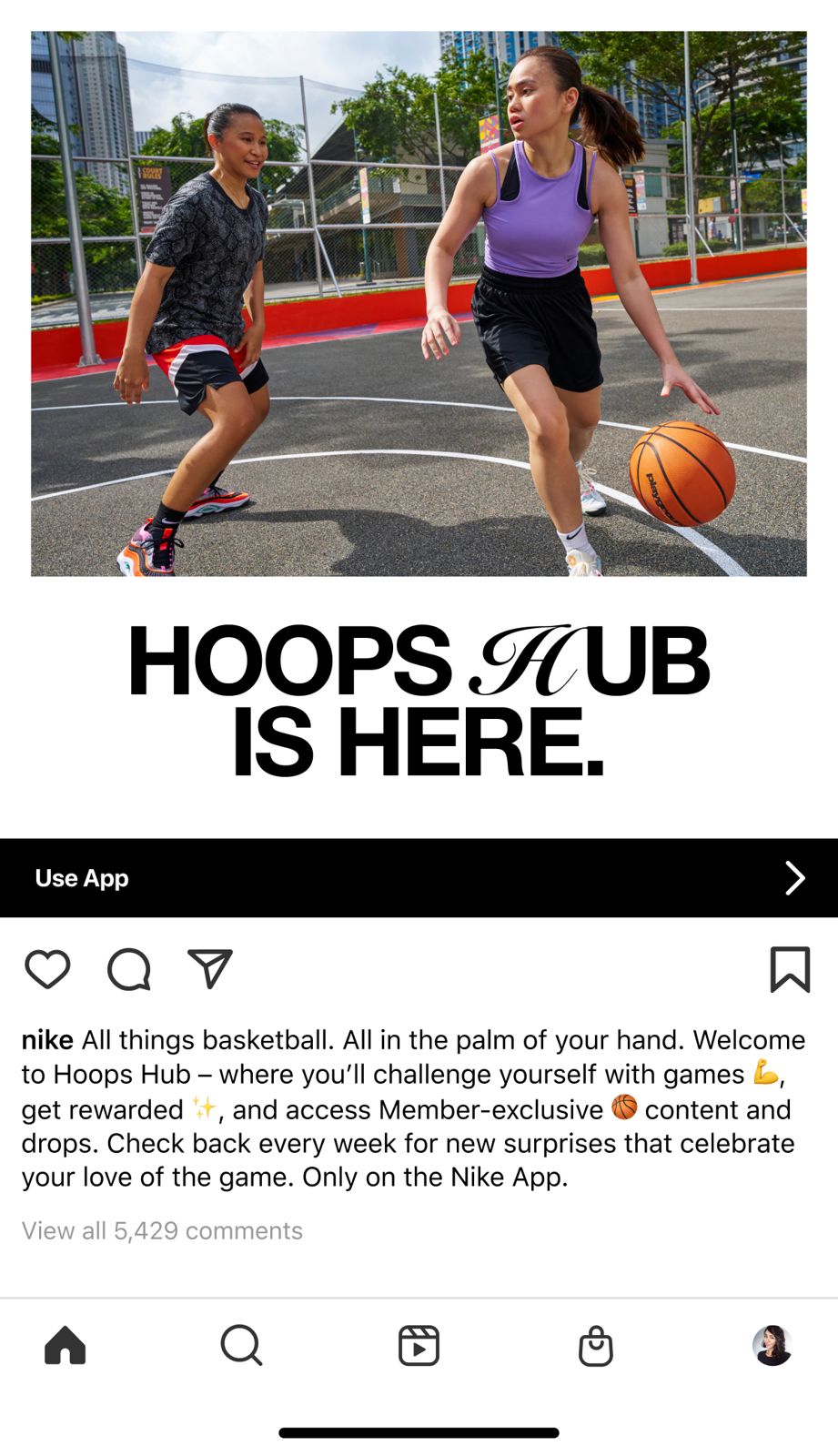
2020 to 2025Nike at the FIBA Basketball World Cup. A sponsorship turned into a playable, rewarding lifecycle inside the Nike app.
2023Juniper Networks was our first client. When the client moved to Google Cloud, the relationship moved with him. Why a client takes an agency with them.
2017 to 2025Building RAPP's regional creative practice from nothing, under live delivery, so that it would run without me.
2017 to 2025Putting generative tools, use cases and governance into a creative team before the network mandate arrived.
2023 onwardTeam X is Omnicom's dedicated model for Mercedes-Benz. Around 1,500 specialists in 47 cities, one brand. The brief for Asia Pacific was not to run launches. It was to keep that one brand coherent across launch, retail, service and ownership, while every market stayed culturally itself.
What has to be held at the centre, and what has to be released to the market? Most brand damage I've seen comes from getting that split wrong. Hold too much and the work goes generic. Release too much and the brand drifts.
Consistency lives in how decisions get made, not in a central approval queue. Global sets intent. The market lead holds the editorial call on cultural translation. We wrote the decision rights down, and every piece of work below ran on them.
EV and combustion sales both grew by double digits in Singapore and Malaysia within three months of the first programme. Review cycles halved. Singapore's service work became the global service campaign for 19 markets two years running. The operating system this work ran on is still in use after my exit.
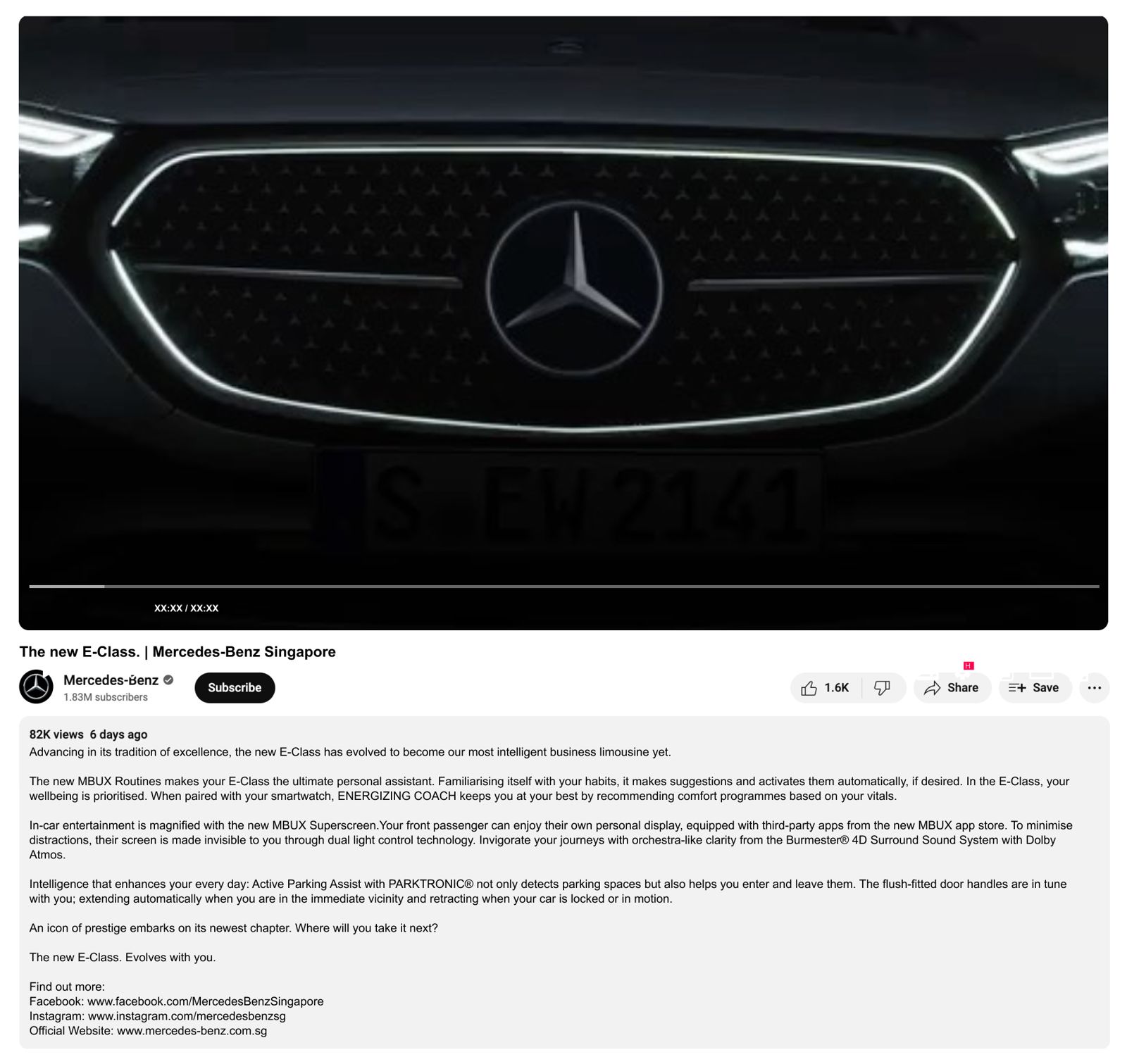
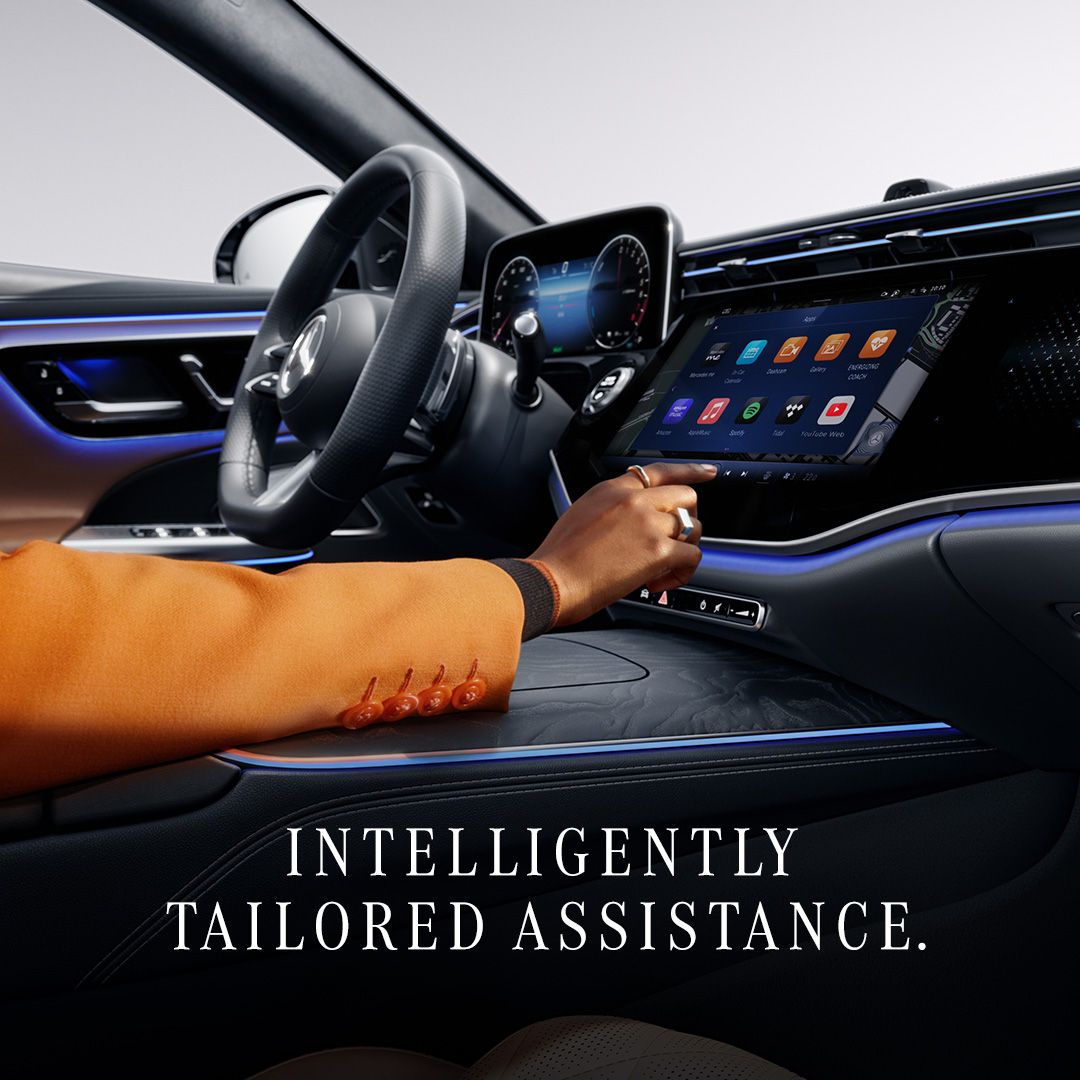
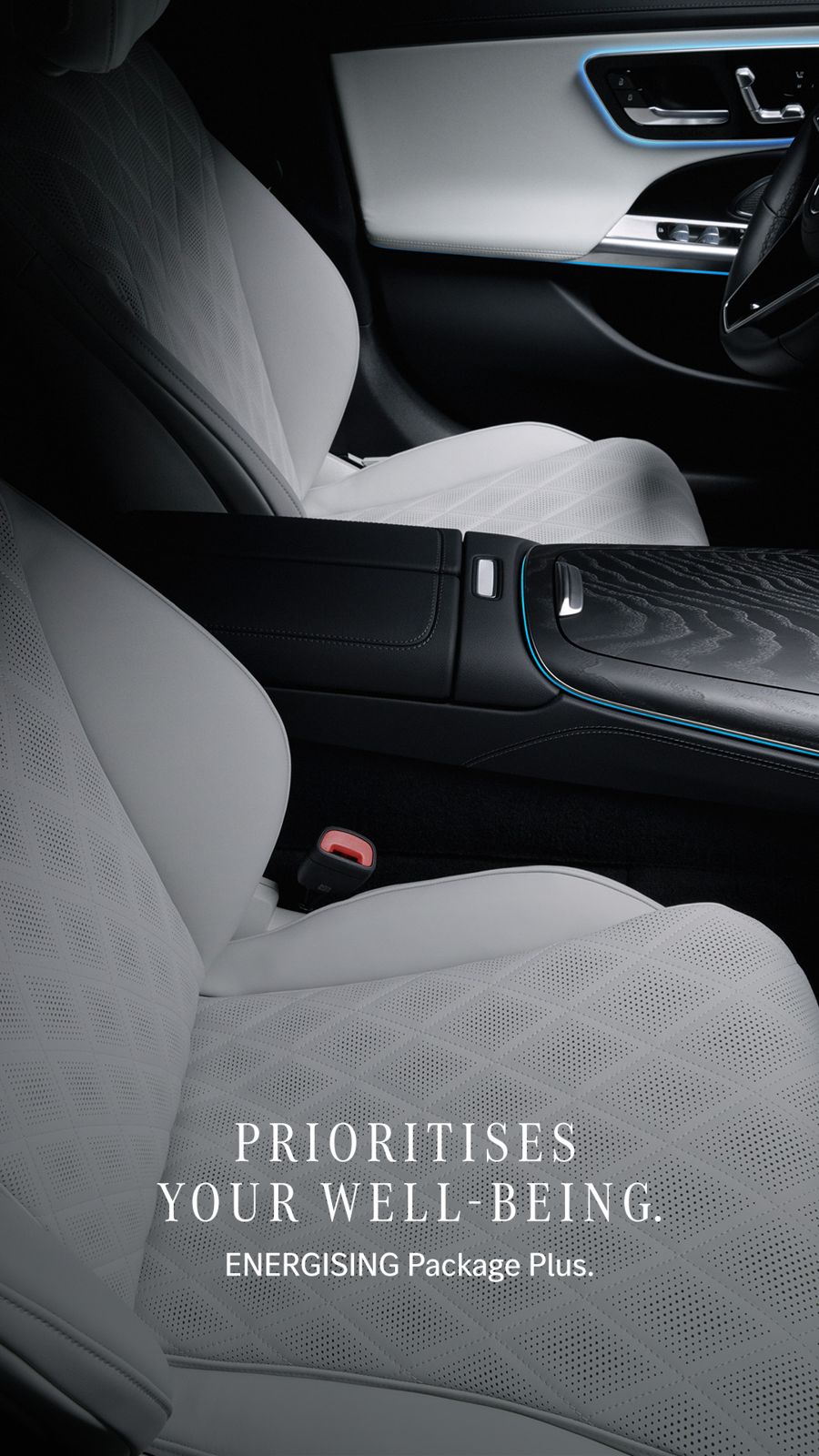
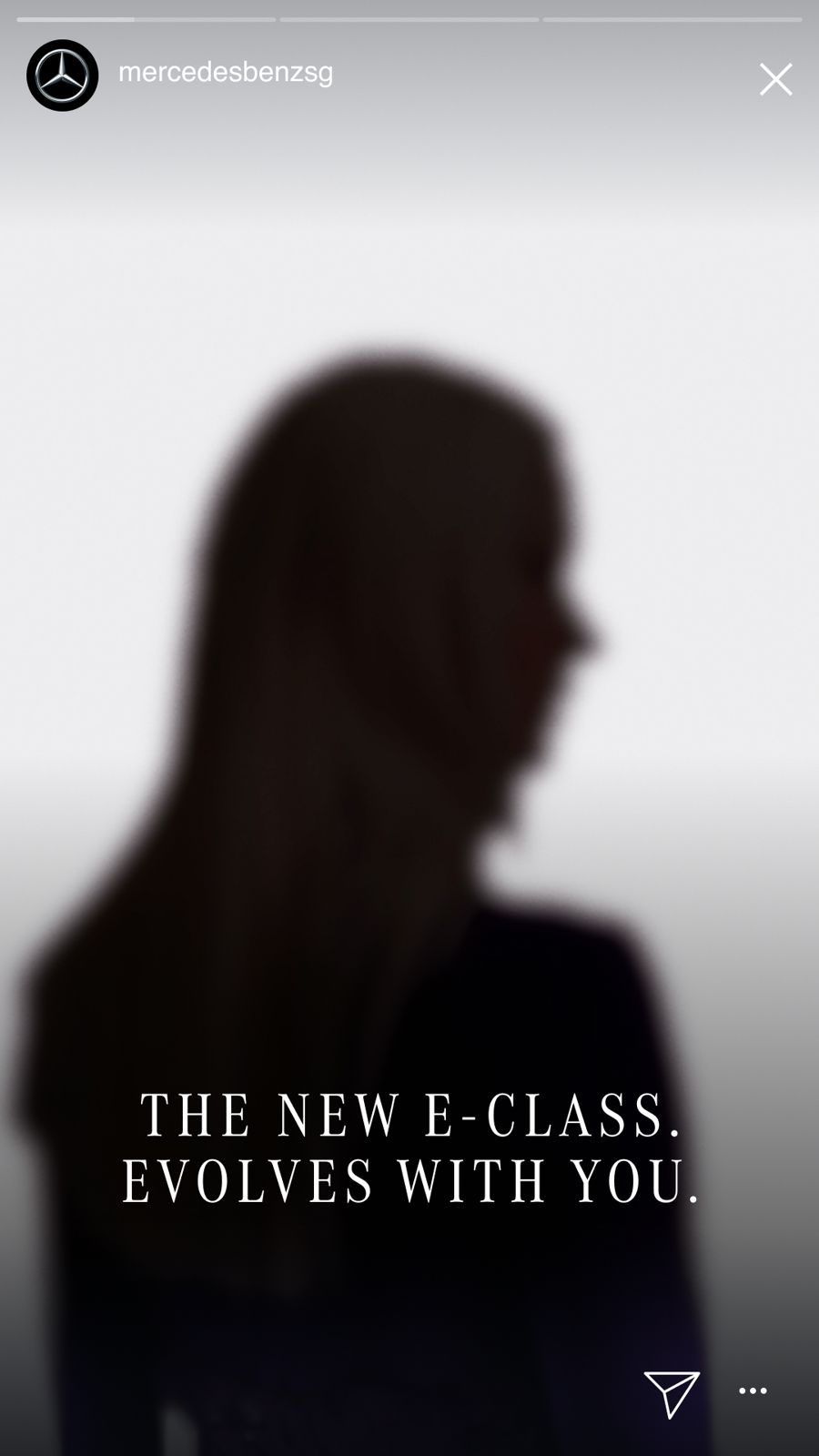
E-Class 2024, EQB, the EQG concept, GLB. Singapore led the regional E-Class launch under this model.


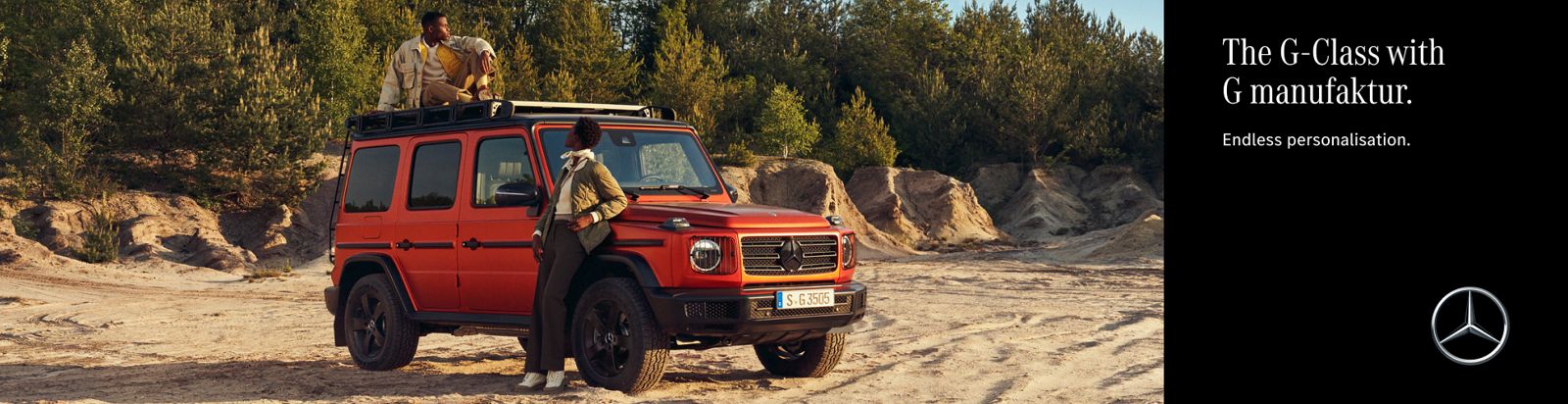
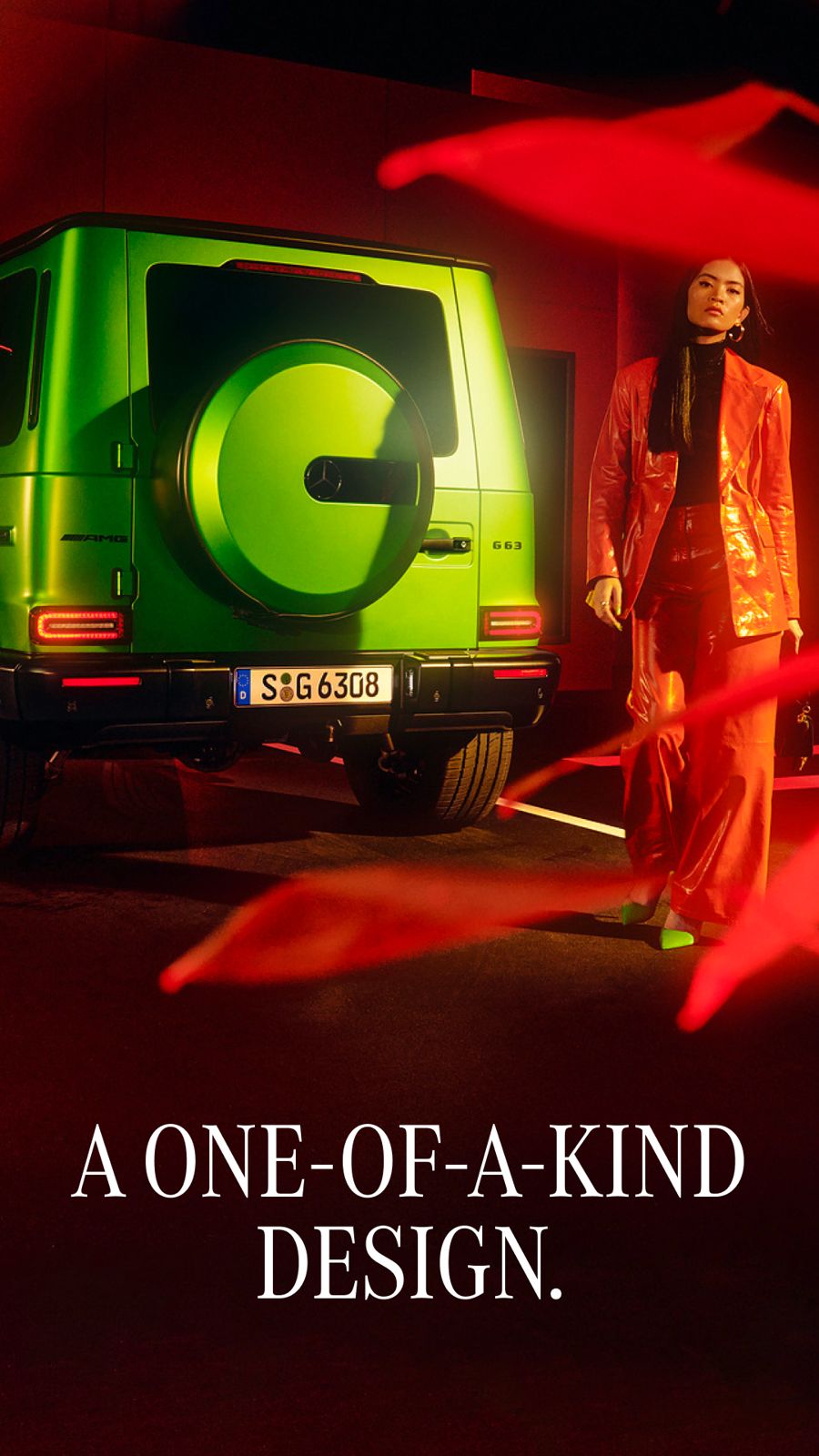
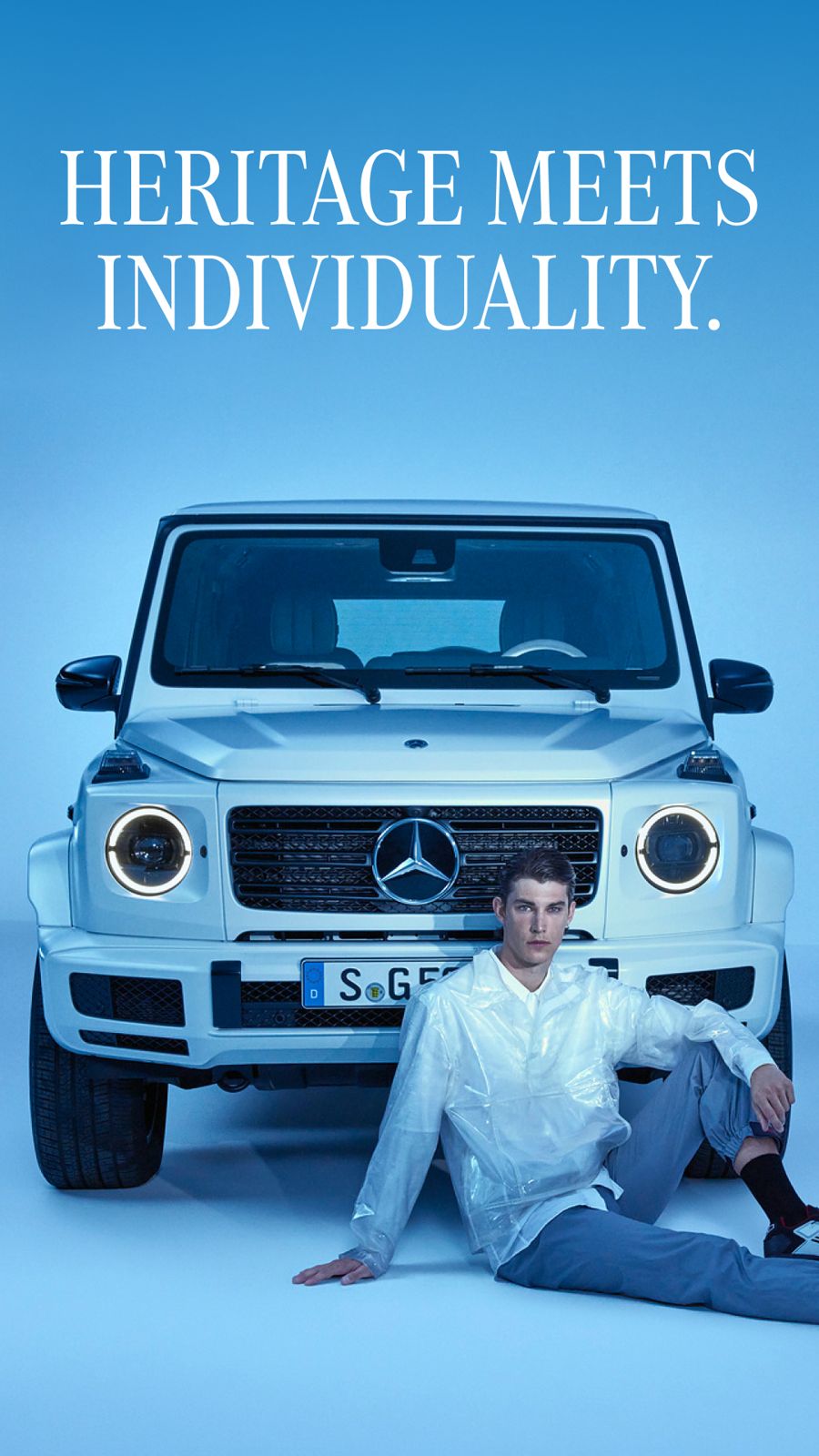
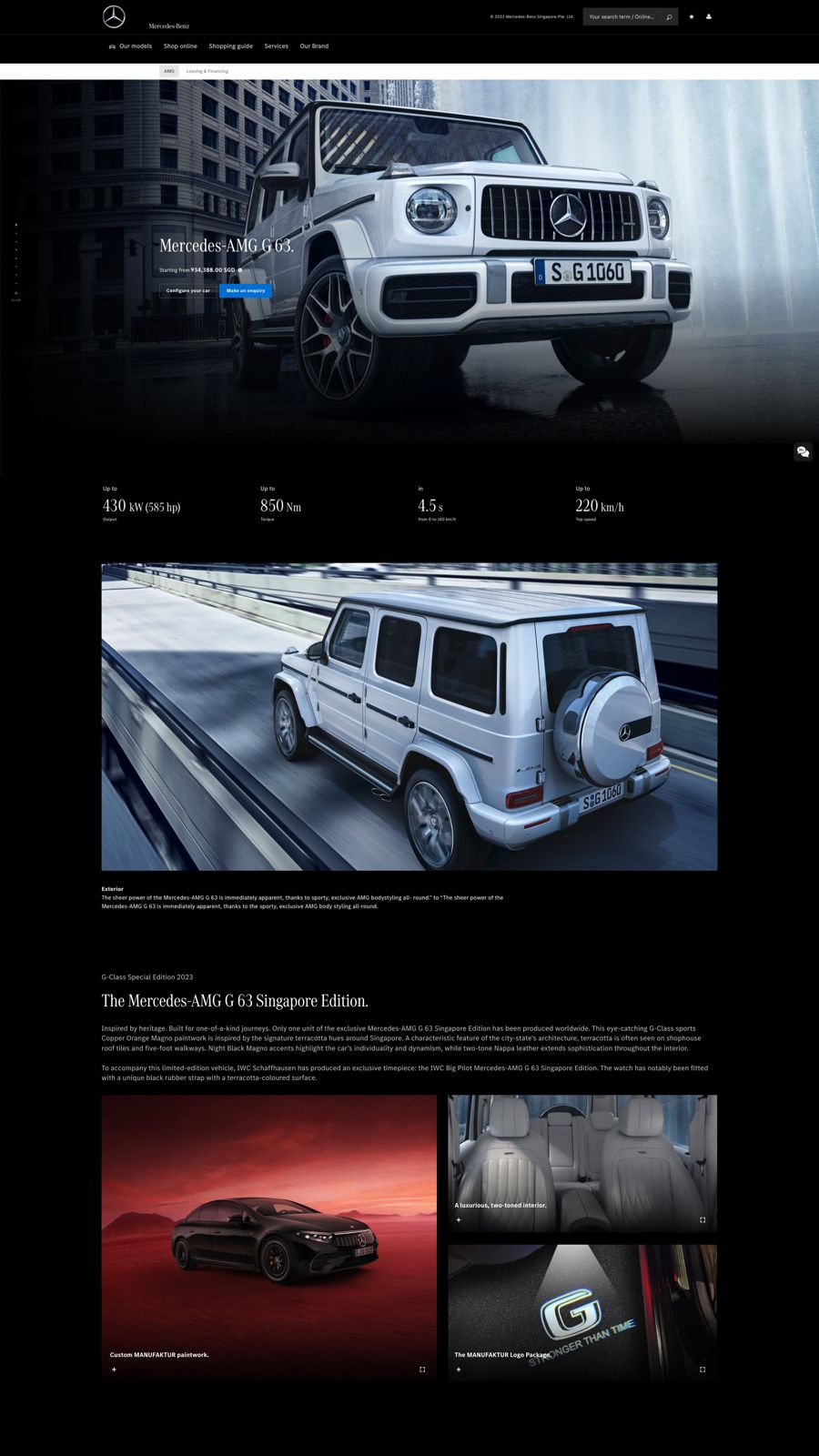
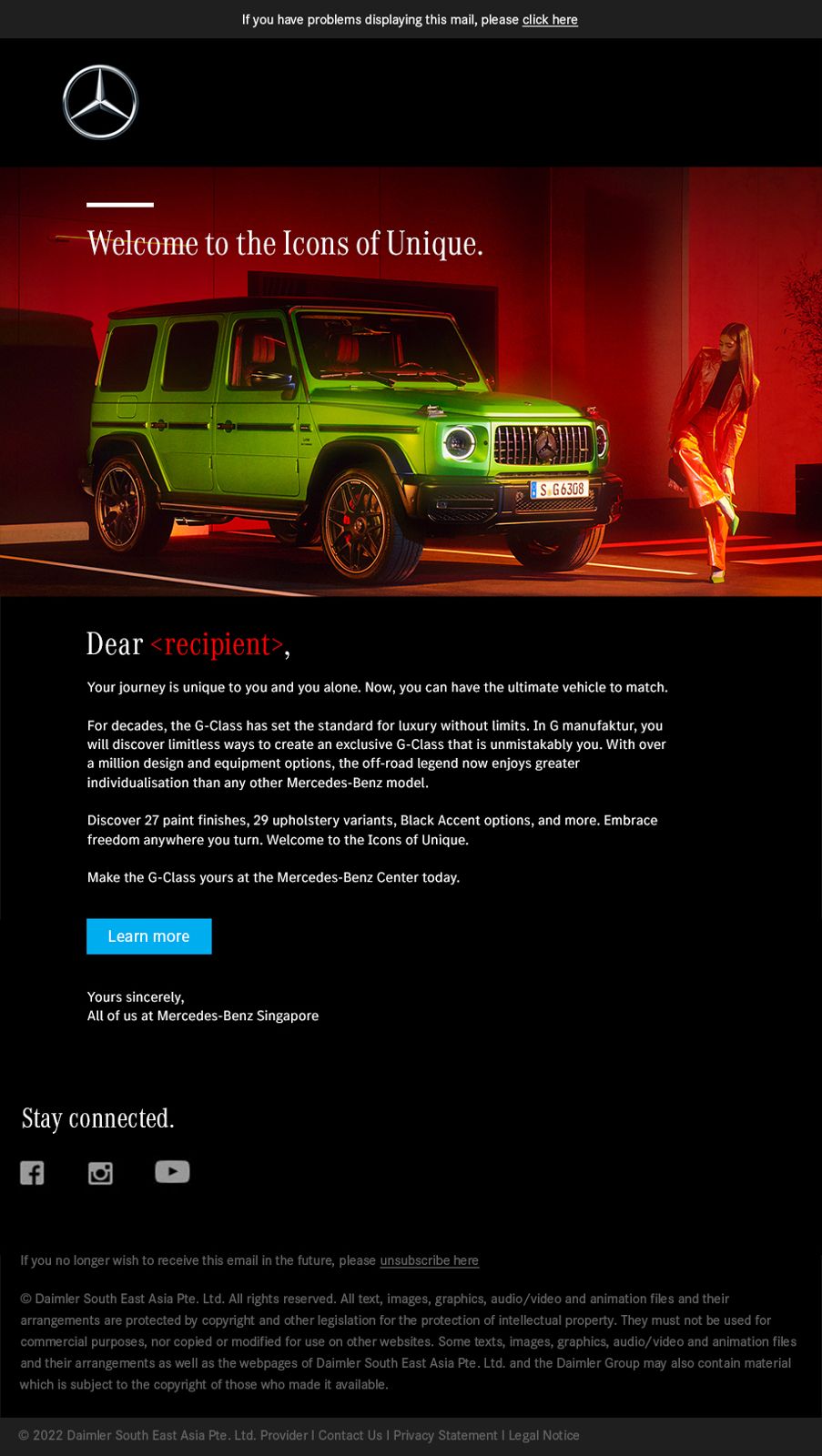
G-Class "Icons of Unique" with three audience cuts. The G 63 Singapore Edition, 15 units, sold through direct-to-collector communications rather than reach. Scarcity runs on a different logic from a mainstream launch. Higher craft, tighter audience, deeper story.

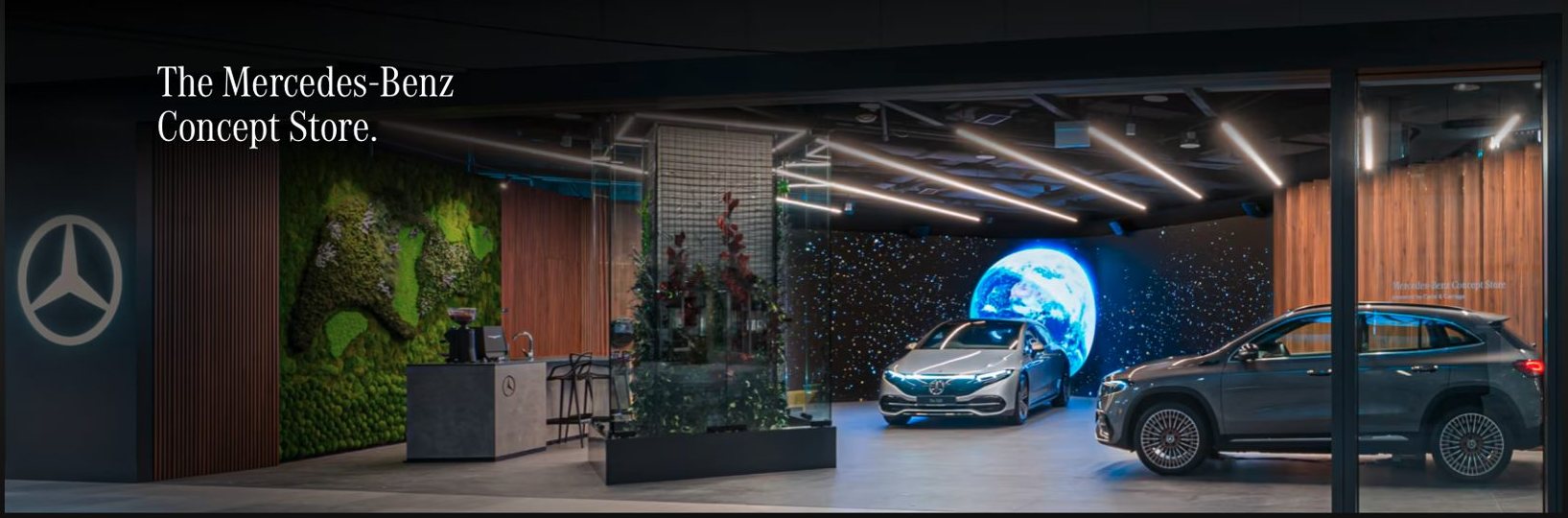
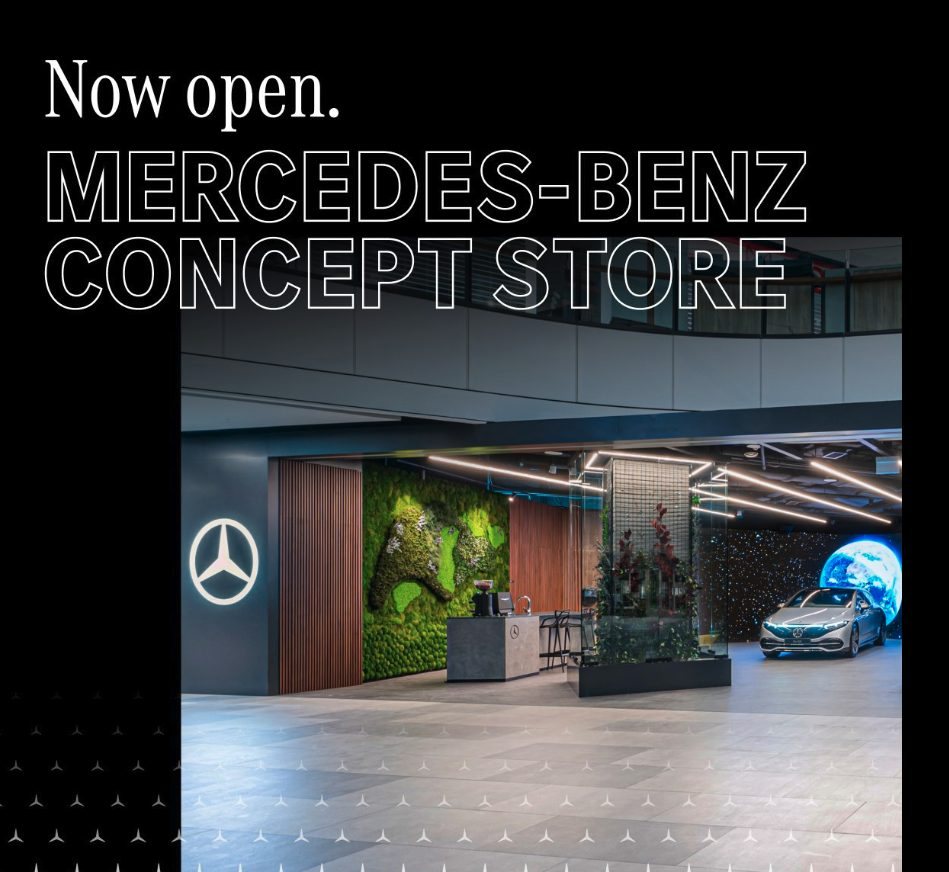
The Mercedes-EQ Concept Store at Great World. A store needs a brand operating system, not a launch campaign. We built a rolling communications architecture around it, with artists, a living moss wall and seasonal product moments, so it worked as both a retail asset and a brand asset.
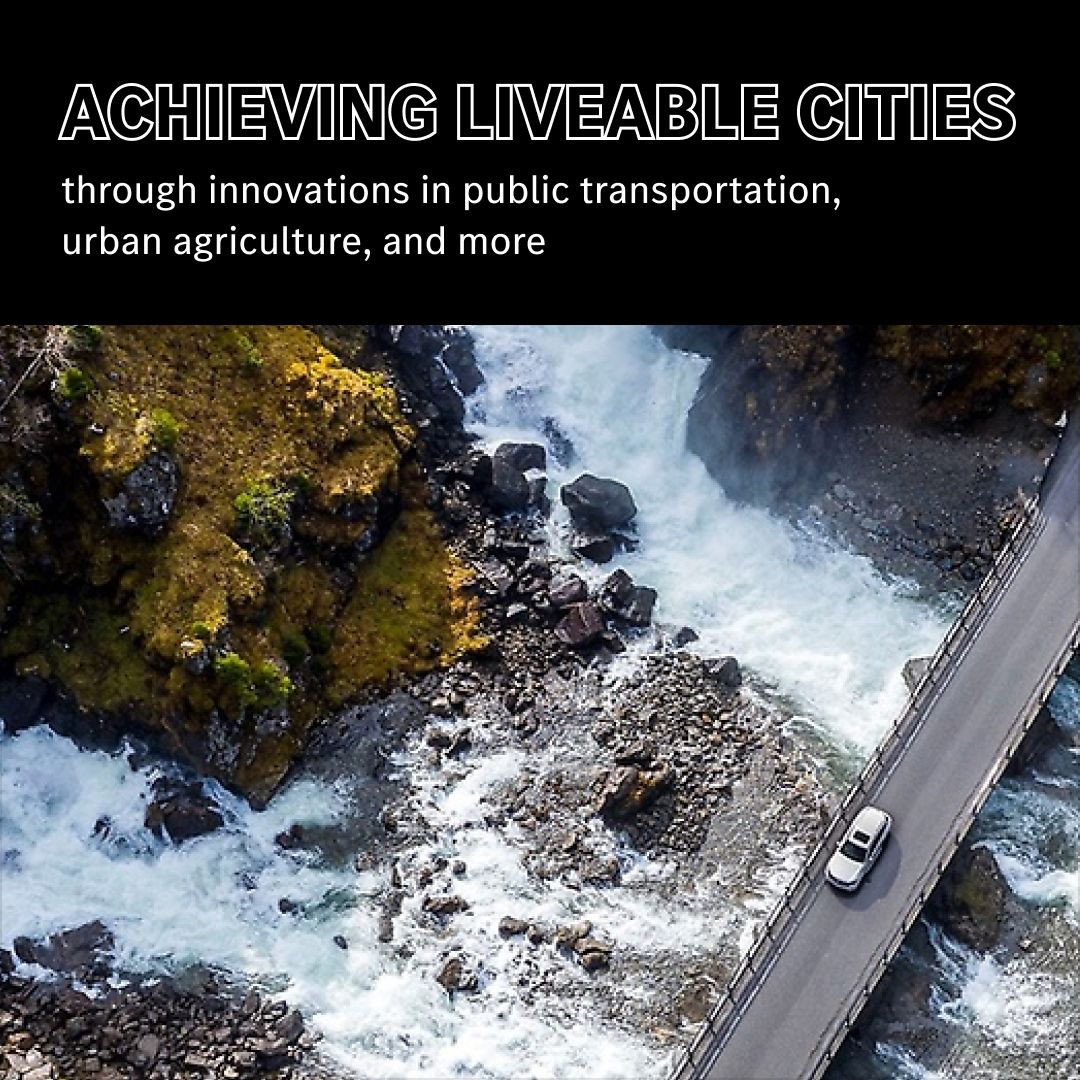
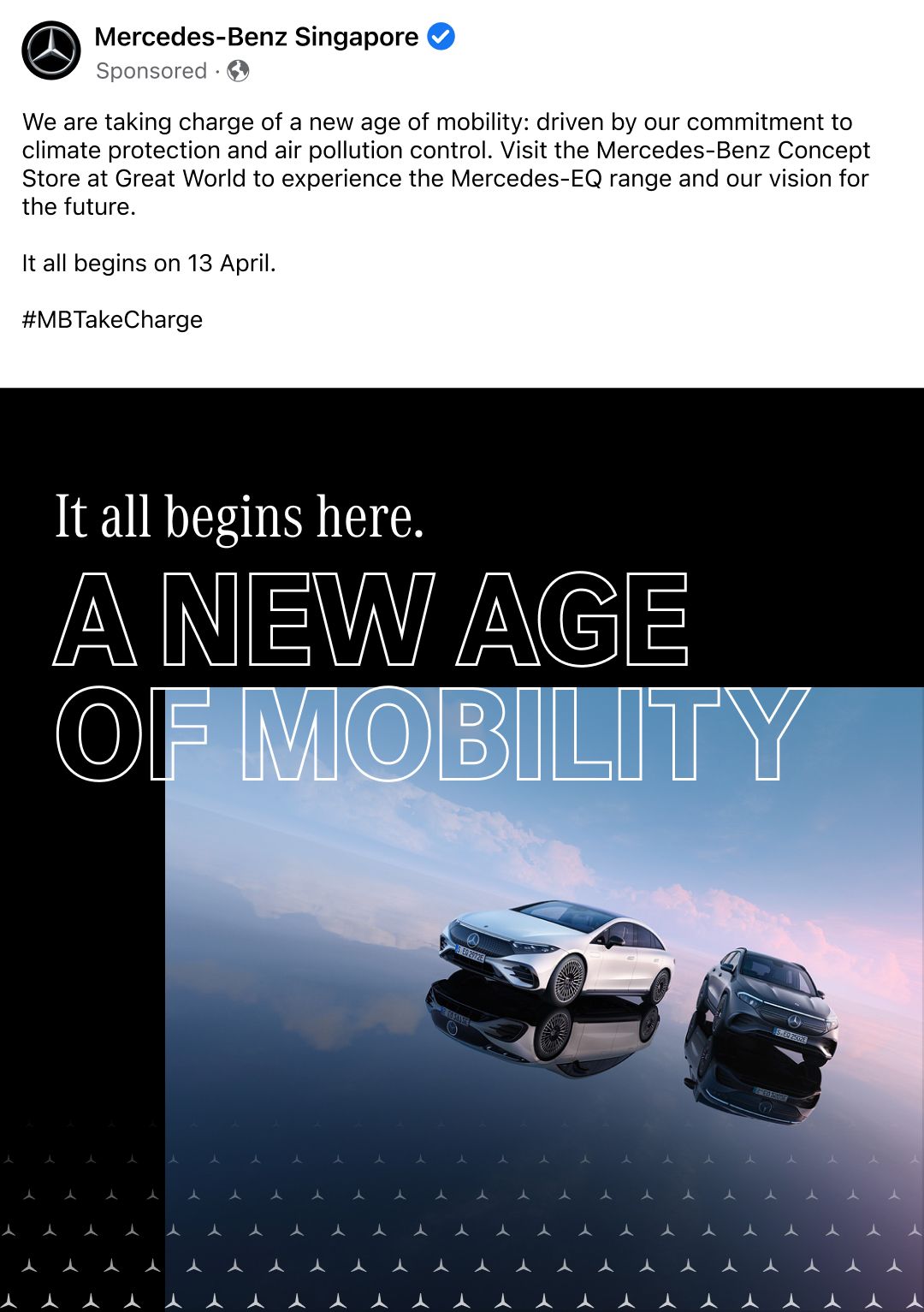
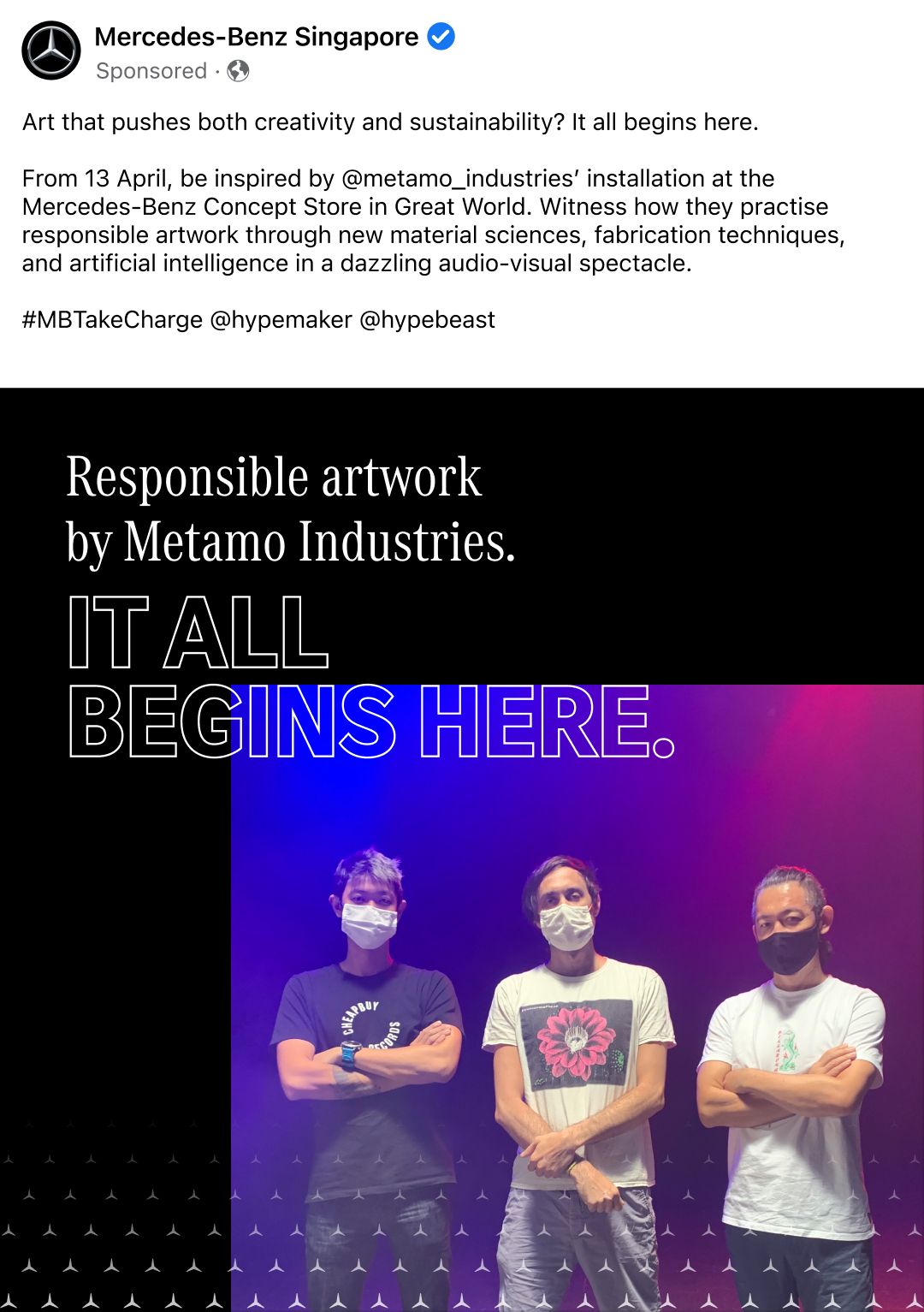
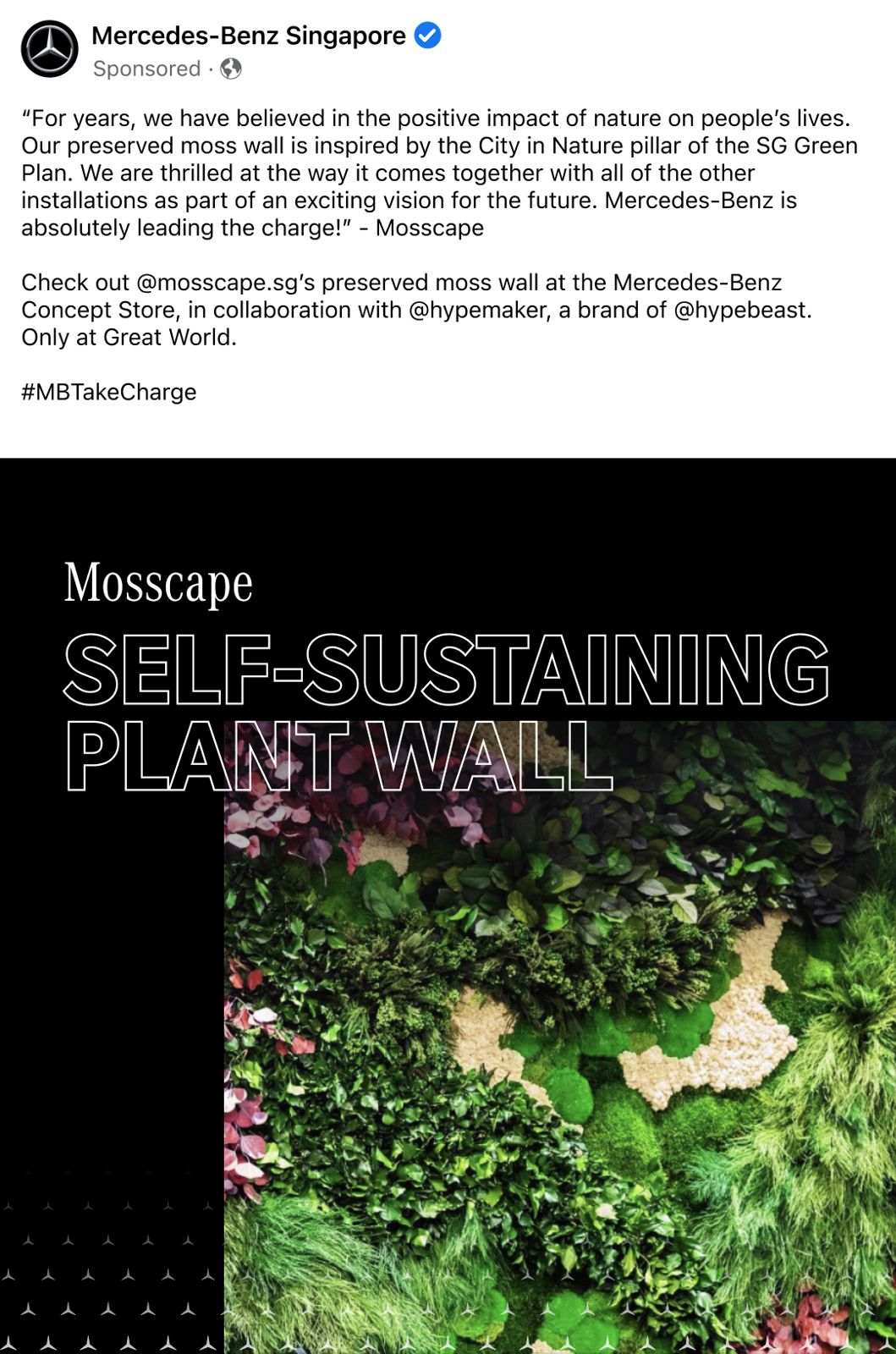
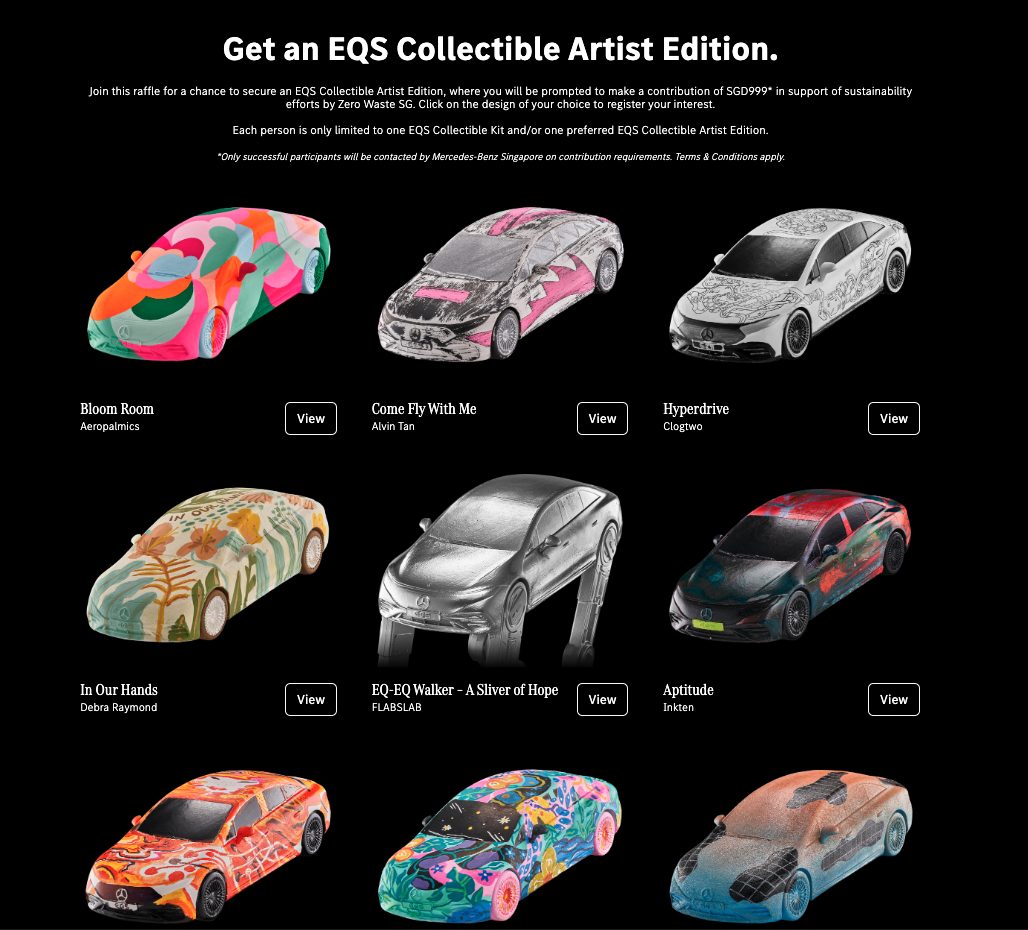
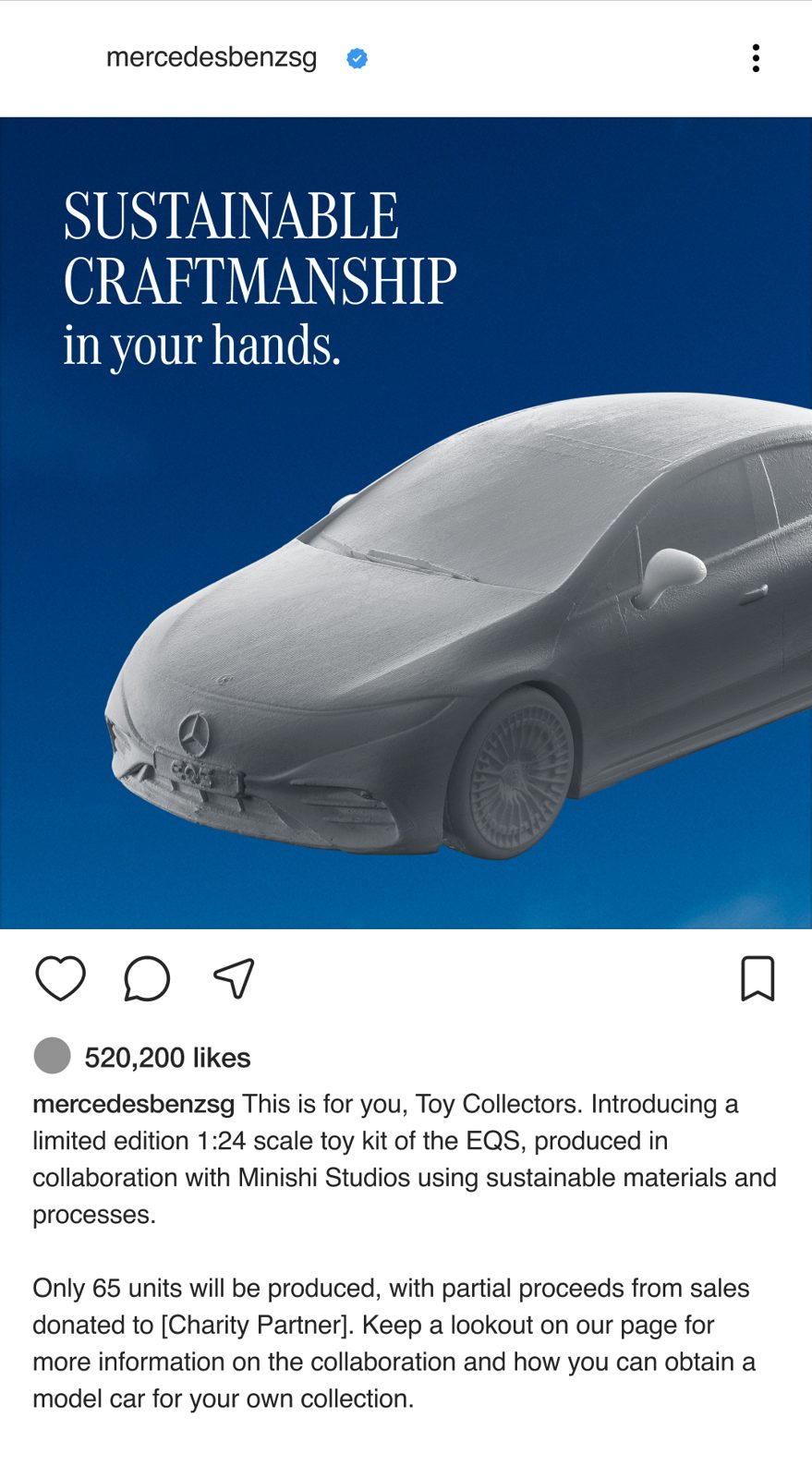
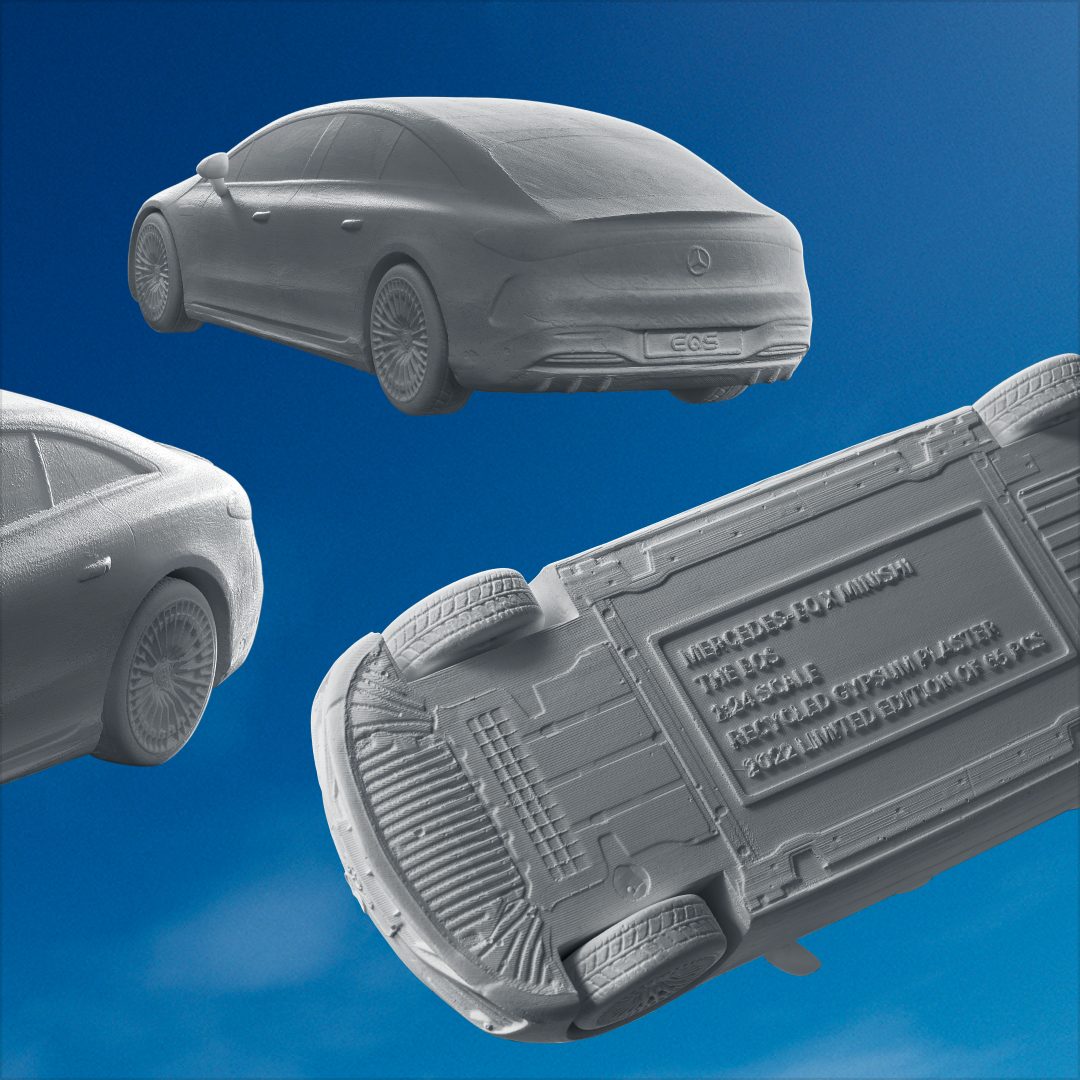
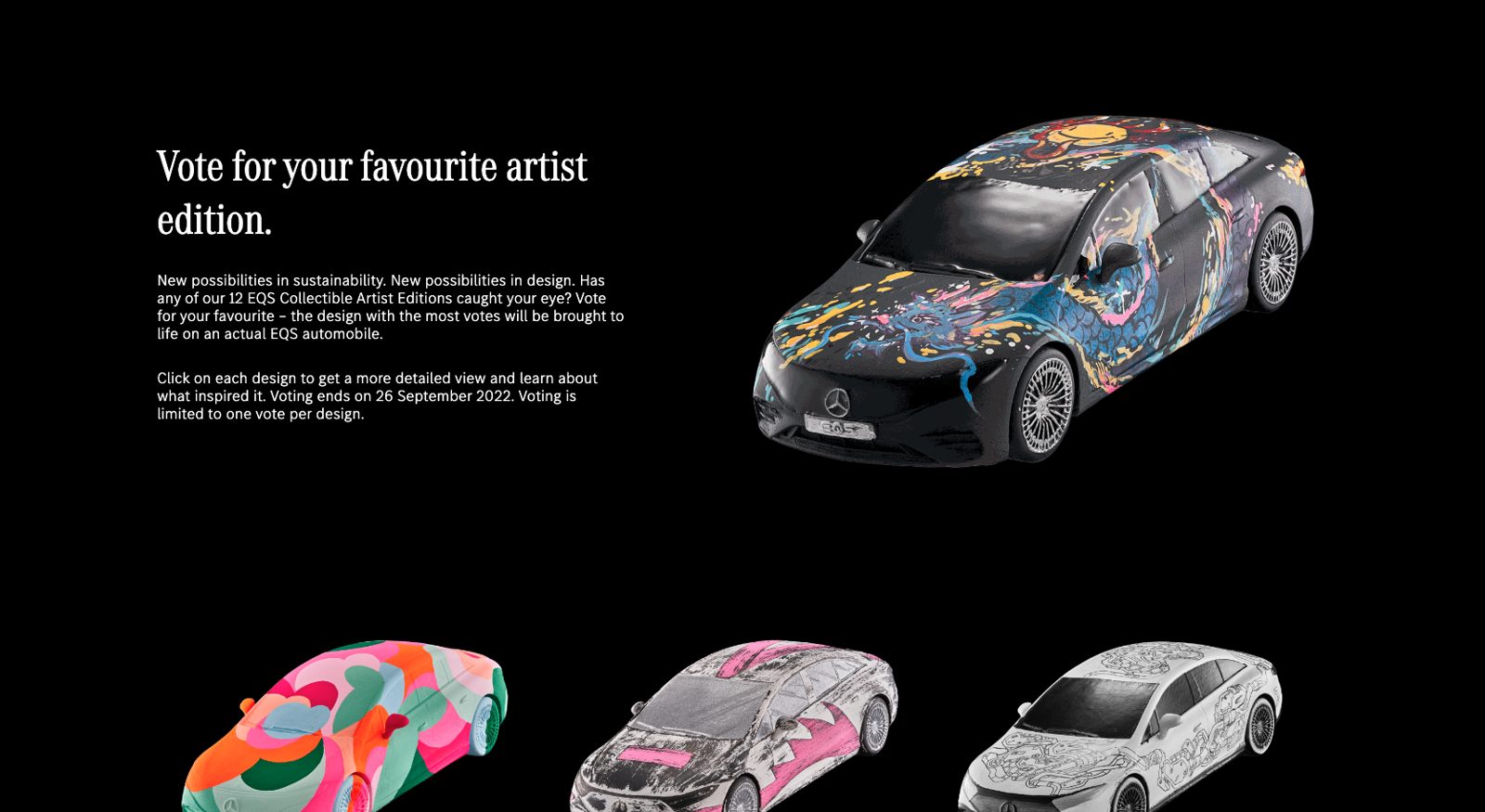
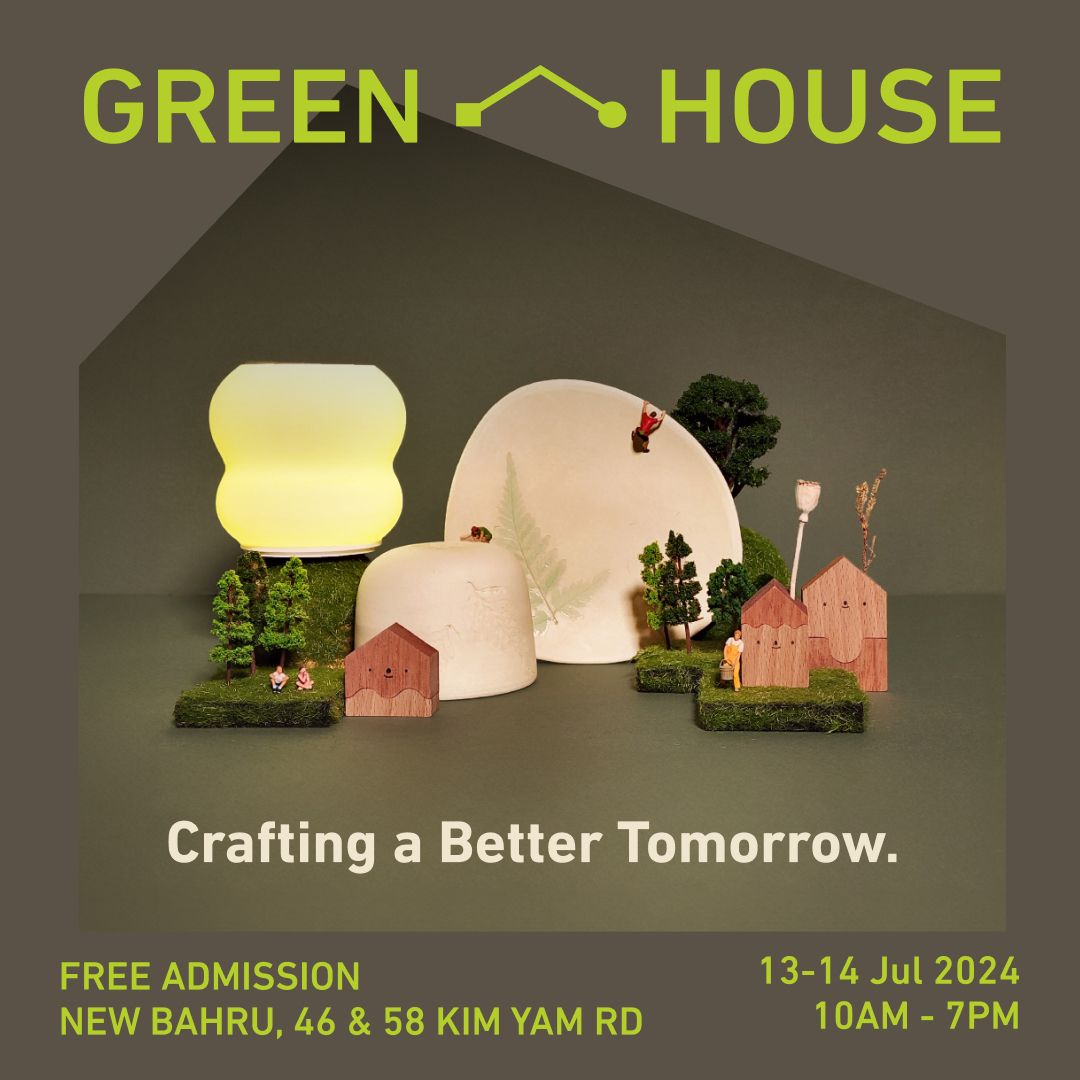
EQS x MINISHI, 2022. Sixty-five miniature EQS, cast by Minishi Studios from sustainable materials and customised by Singapore artists, sold through the Concept Store with proceeds to charity. The public voted for the artist editions. Sustainability earns brand credit only when it carries the brand's voice, not when it sits in an ESG silo. GREEN-HOUSE 2024 carried the same logic into a public showcase two years later.

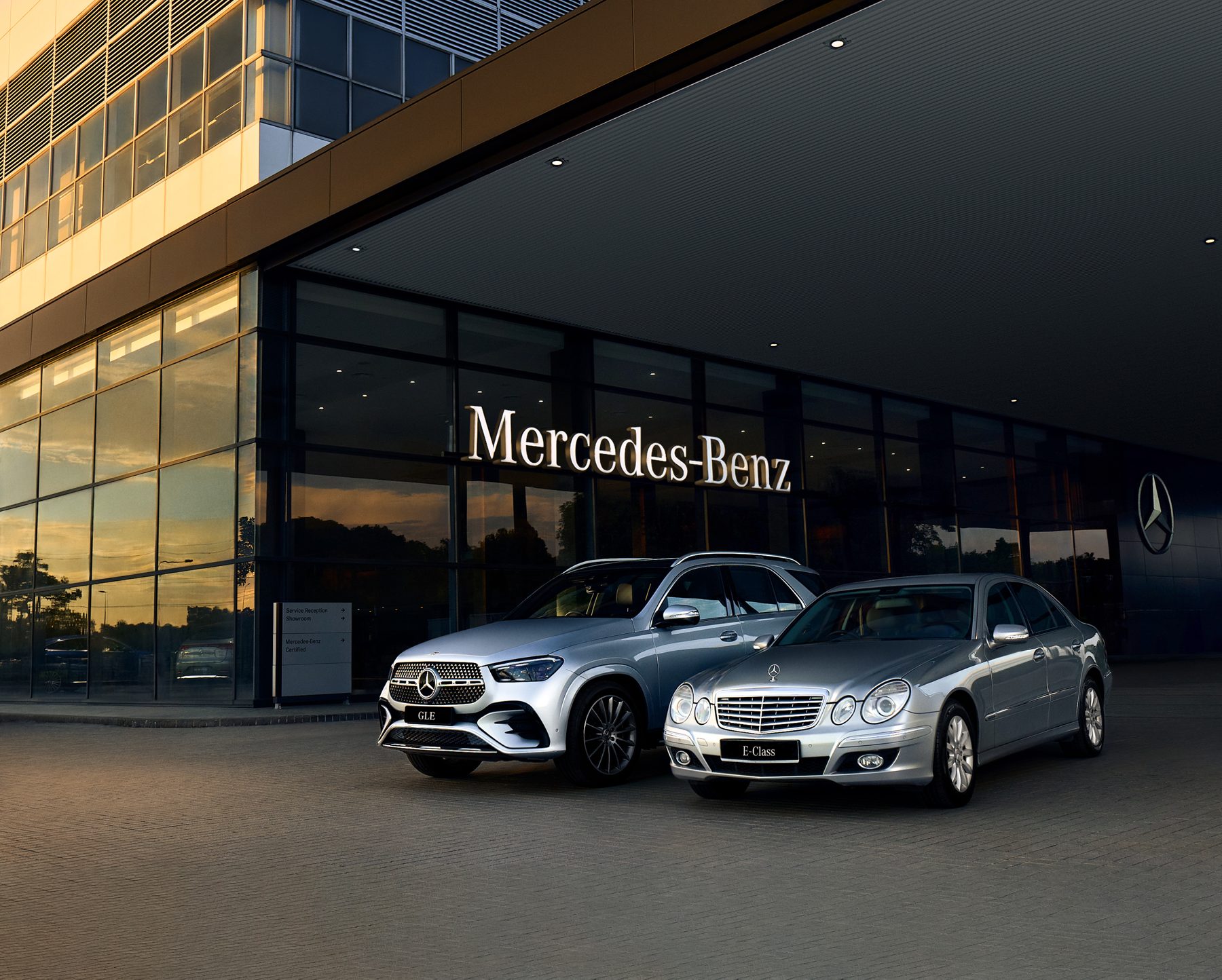
Retention earns less attention than launches and drives more revenue. After-sales had to feel as premium as the car. Asia Pacific was handed the global campaign two years running.
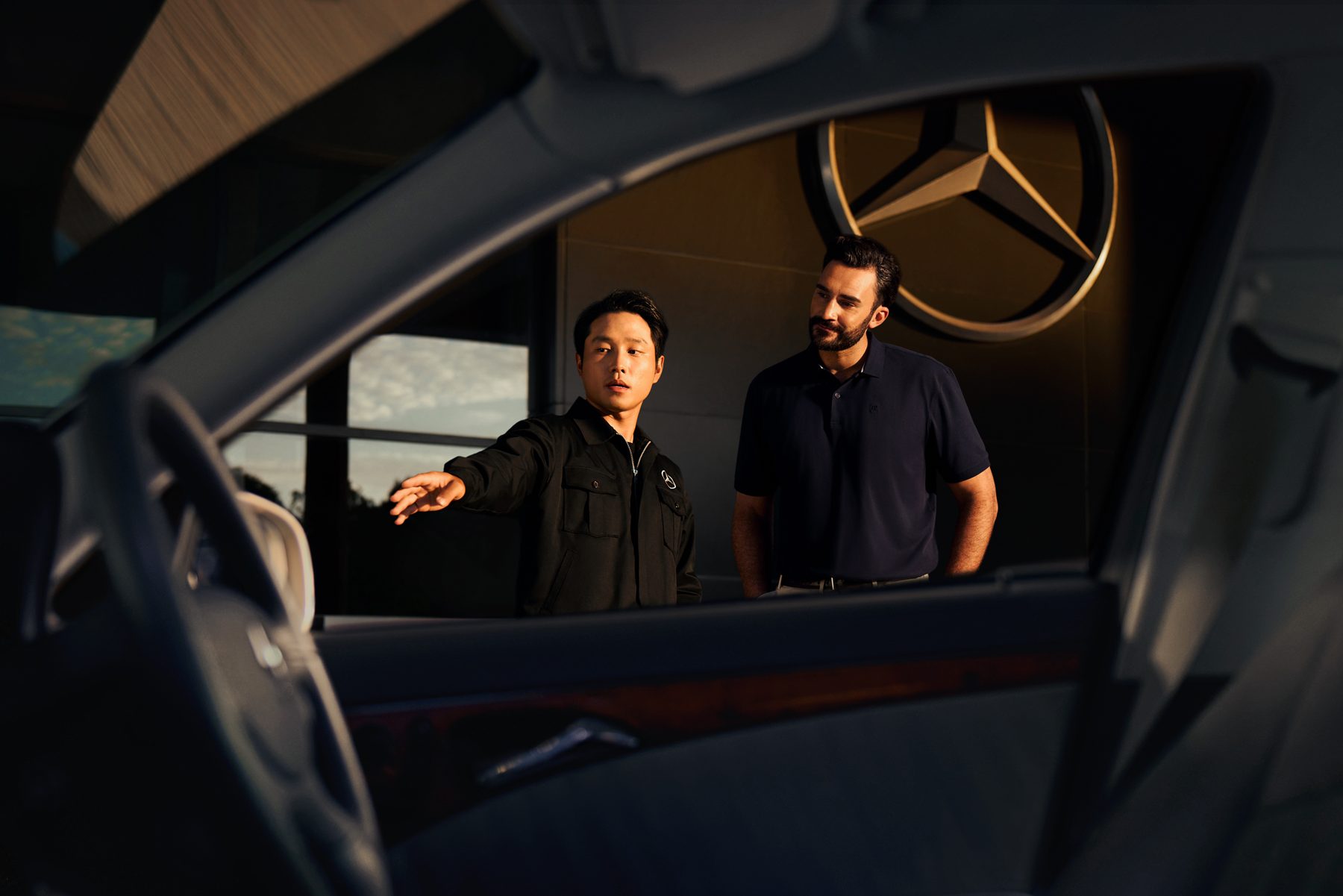
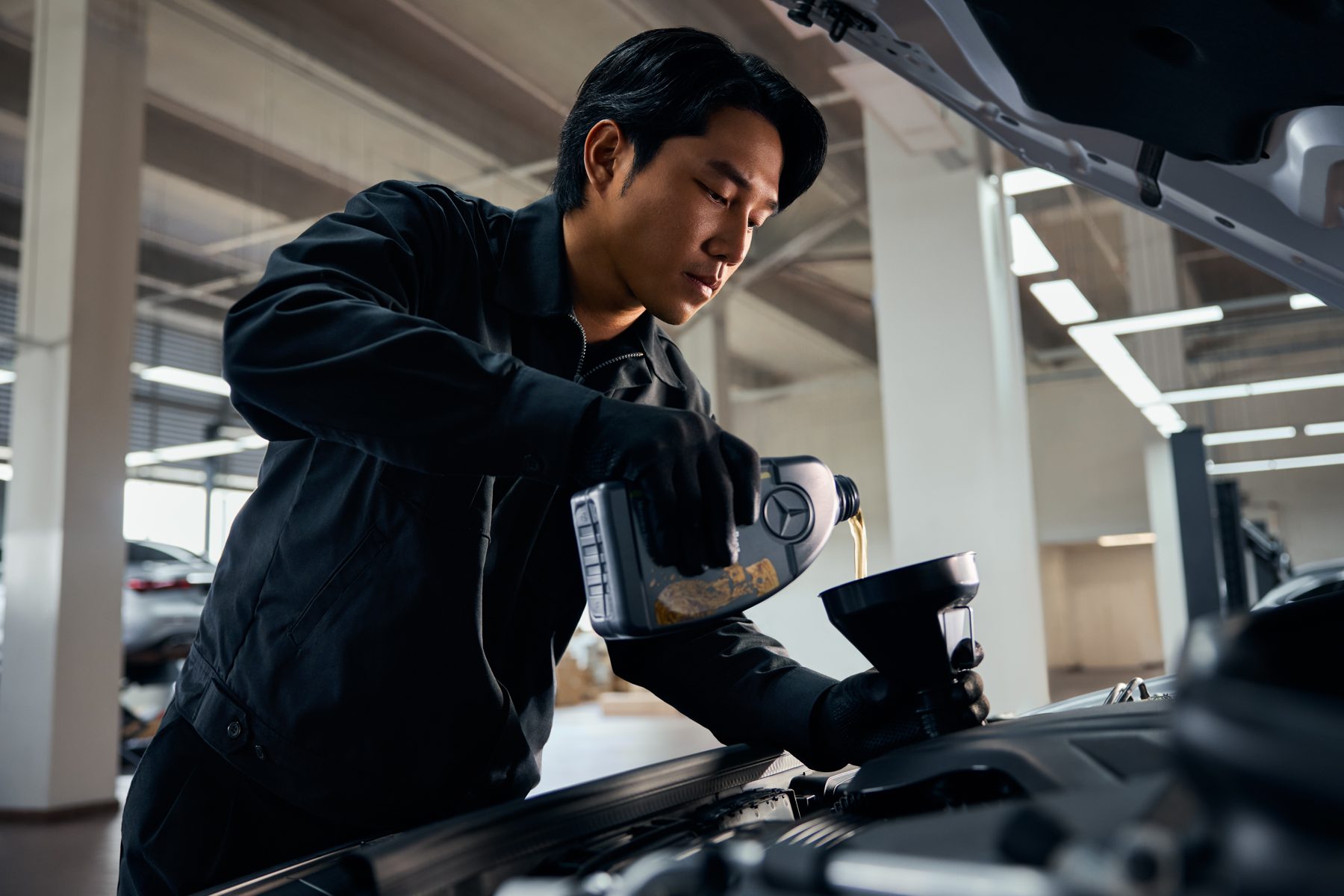
The client liked the Singapore work enough to hand Asia Pacific the global service campaign. One film and one print system that had to stay evergreen across 19 markets with holiday calendars and cultures that share almost nothing. We took our Singapore production house to a hangar in Malaysia, flew talent in from Bangkok, Singapore and Malaysia, and shot the whole campaign in one production. The logistics were the creative problem. Every scene had to resonate in Dubai and South Africa without a reshoot.

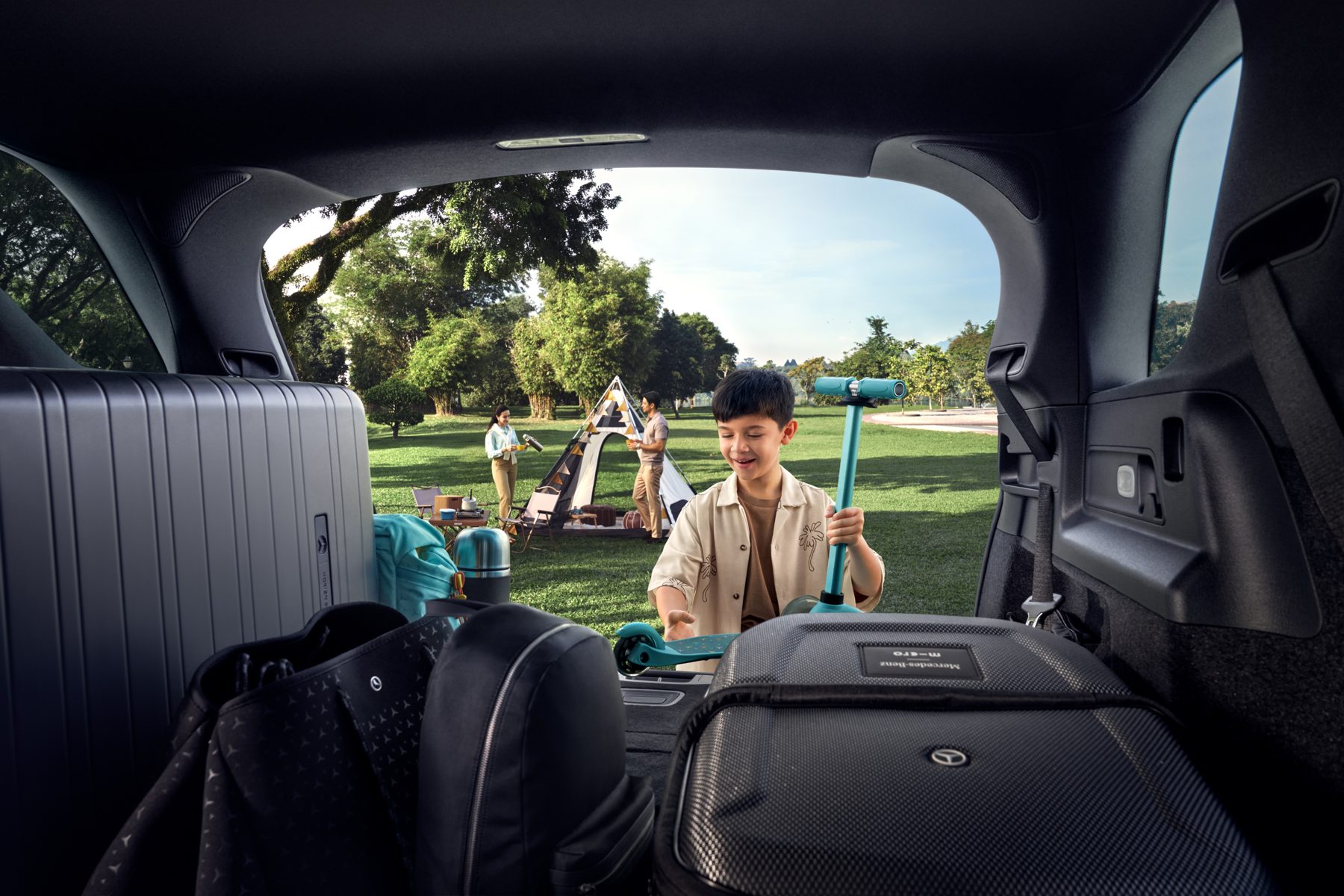
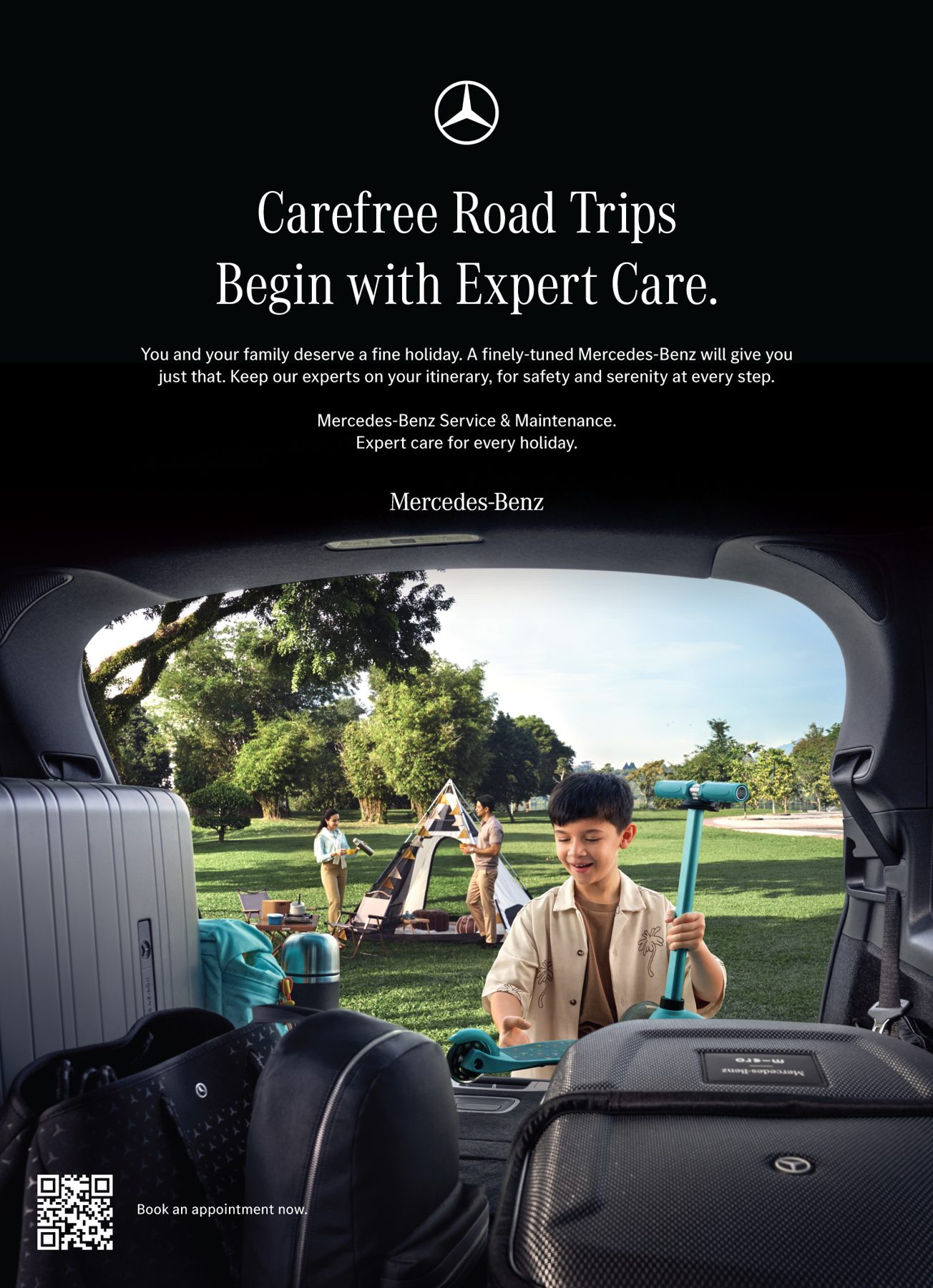
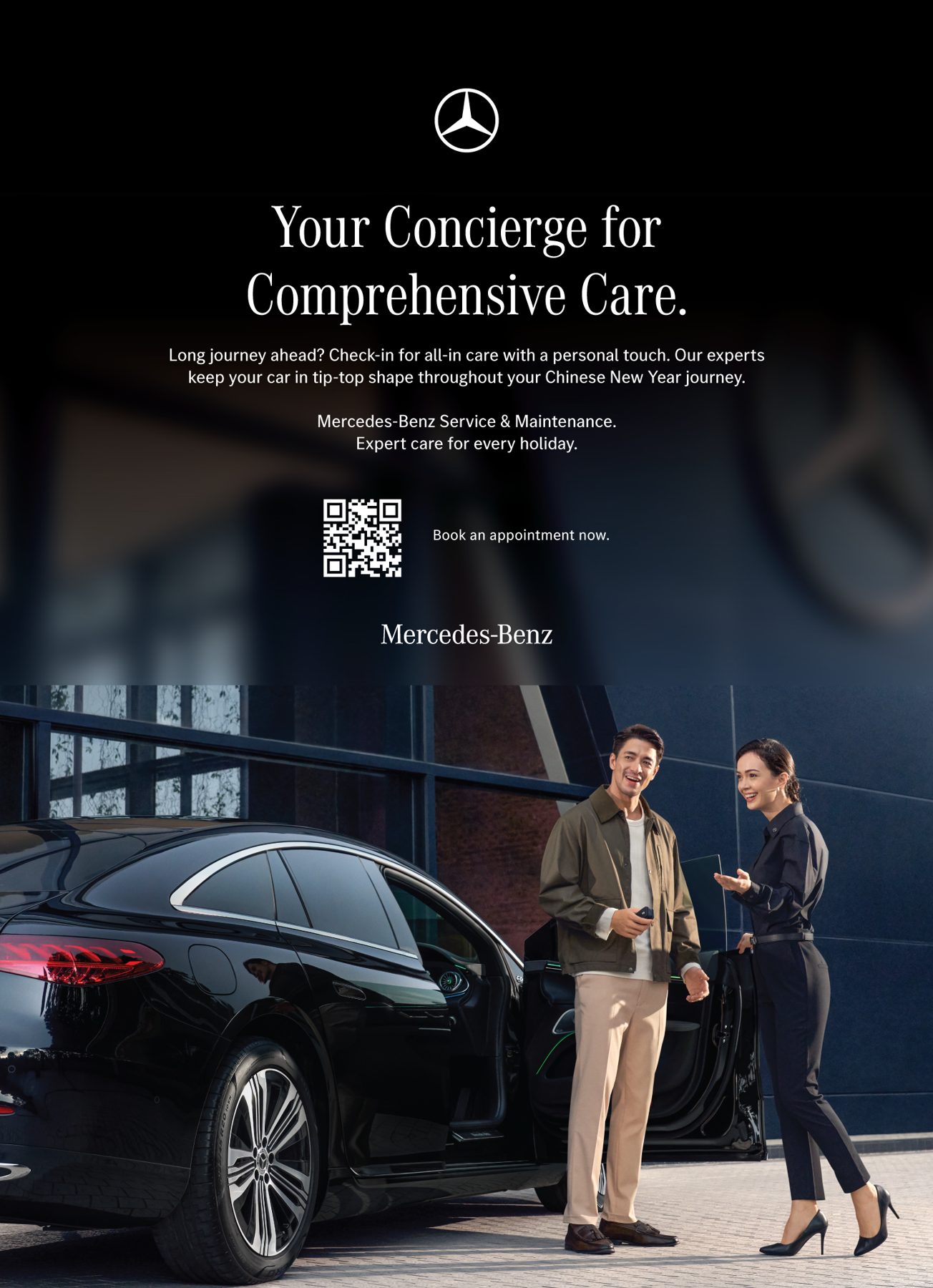
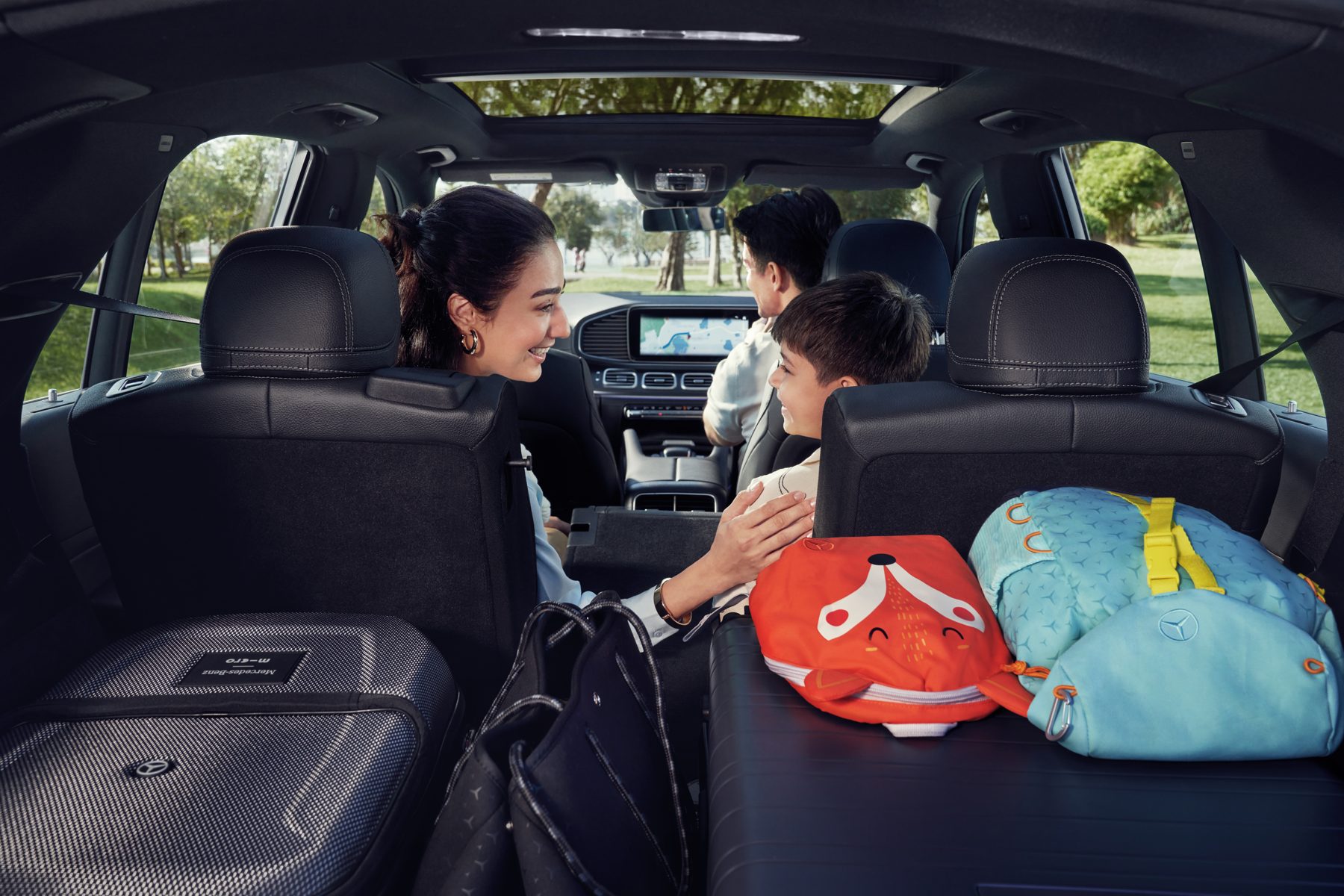
The second global campaign in a row, and the film I am proudest of. One minute, one idea, every market, nothing left to be reinterpreted locally. A child asleep in the back seat, a technician under the car at night, a family coming home. Service as the quiet promise that the car will always get you there.


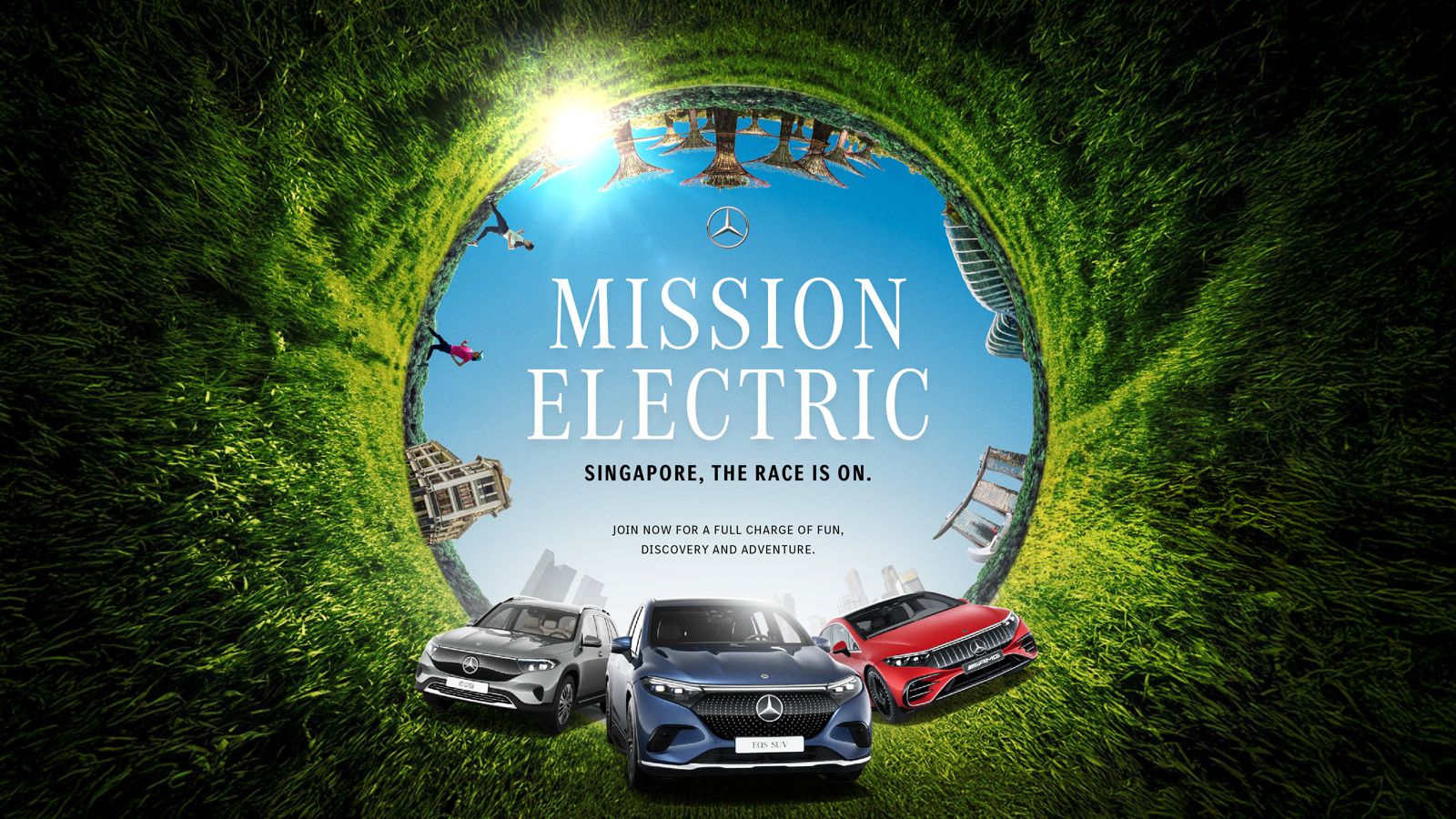
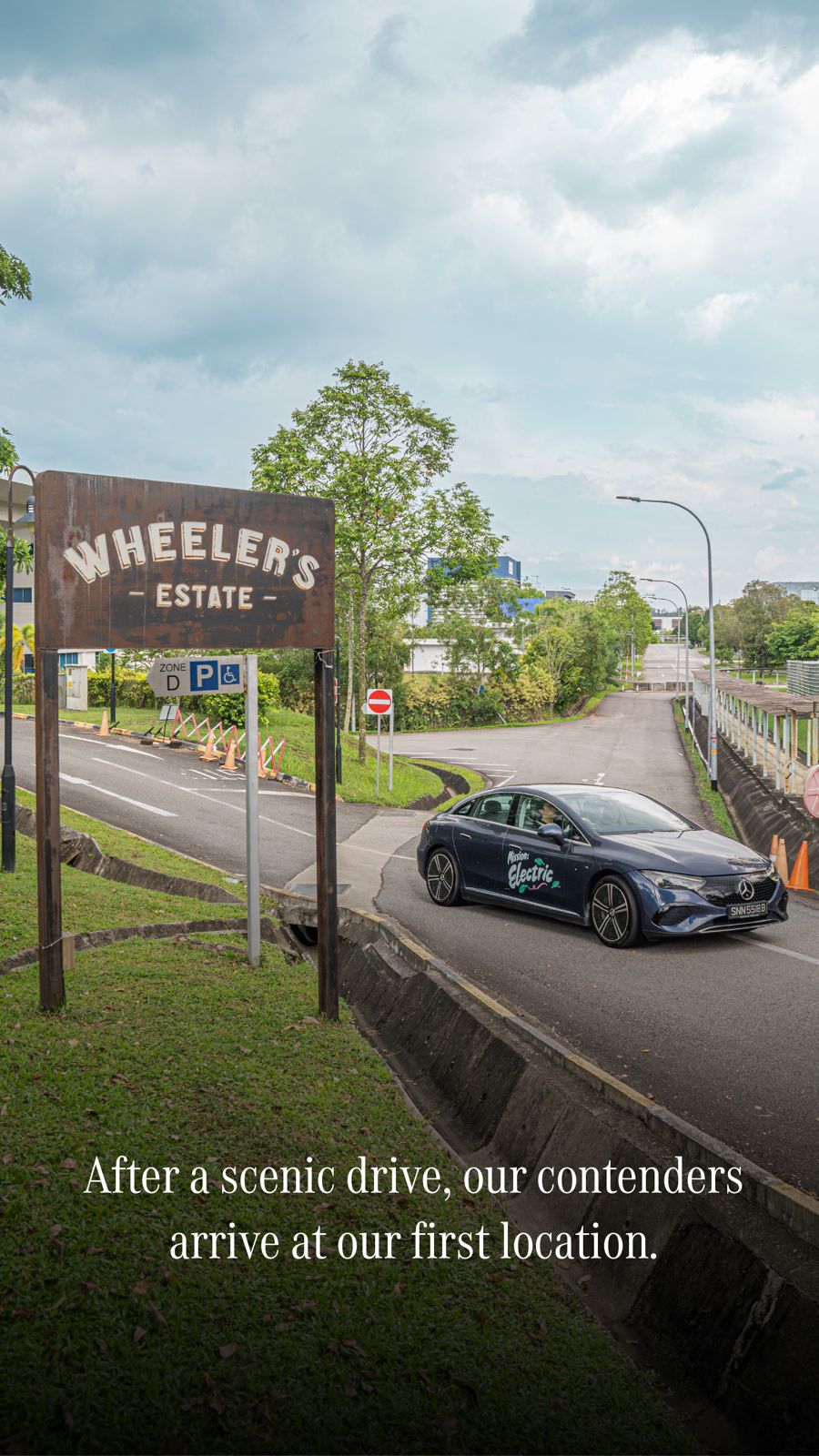
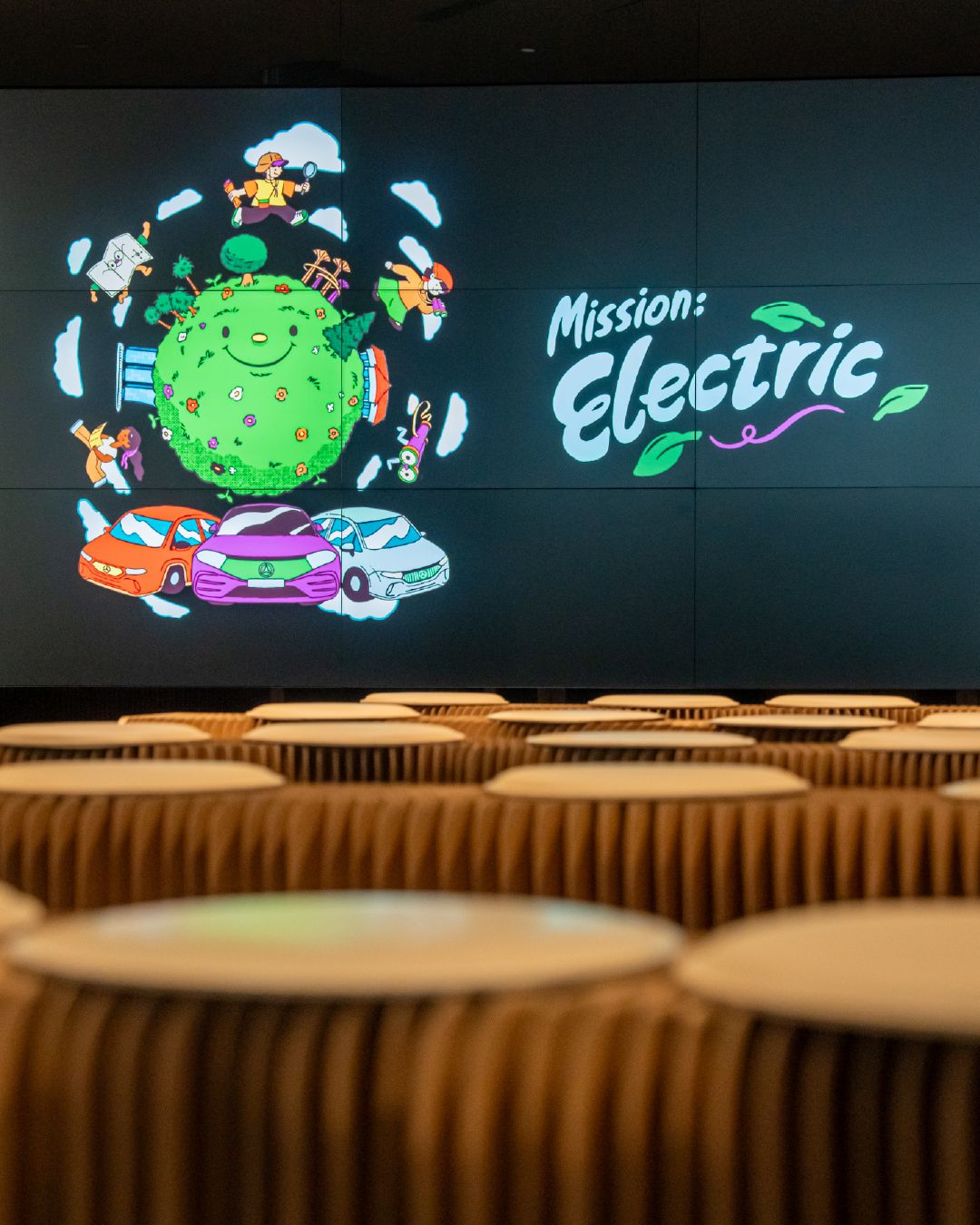
Mission: Electric 2025. An EV drive experience across Singapore, built to put sceptics in the car rather than in front of an ad.

Governance is a creative tool. Get the decision rights right and the work gets braver in every market, not blander.
Nike trusted us with the member side of the brand in Southeast Asia and India: the app, nike.com, email and push, every week, from the first lockdown in 2021 through to live events in 2025. Then the FIBA Basketball World Cup came to Manila. Sponsorship buys presence. It doesn't buy a relationship. The brief was to turn three weeks of basketball into reasons to be a Nike member long after the final.
What would a fan do on their phone between games? Not what would they watch. What would they do.
Build around the member, not the campaign. Real people in their own cities, shot locally when nobody could fly, published through every channel the app had. For the World Cup, the same logic at full scale: a lifecycle around the fan, not a campaign around the sponsorship. Hoops Hub in the Nike app as the home. Super Hoops, a playable game with rounds and real rewards. Her Hoops, a women's 3x3 tournament with its own recruitment flow. Flight Camp for the Air Jordan 38. A jumbotron QR moment in the arena that fed the app. A Luka vs Luk AI challenge. Every idea shipped as an inbox message, a push, an email and an app thread, so one creative thought ran through every member channel.
The target audience kept Nike top of mind for the length of the tournament, and the programme led them into the Nike store to buy basketball gear. Nike's regional teams could run the toolkit themselves afterwards, which is the point of building a system instead of a stunt.
2021 to 2022. Nike Dance in Singapore, India and Indonesia. Sports bra stories with Thai pro-athlete Mai Dangda. Member Days in Malaysia. Real members and athletes in their own cities, directed across borders when nobody could travel. Local crews, remote direction, one creative standard, and every story shipped as a film, a feed card, a thread, an email and a push.
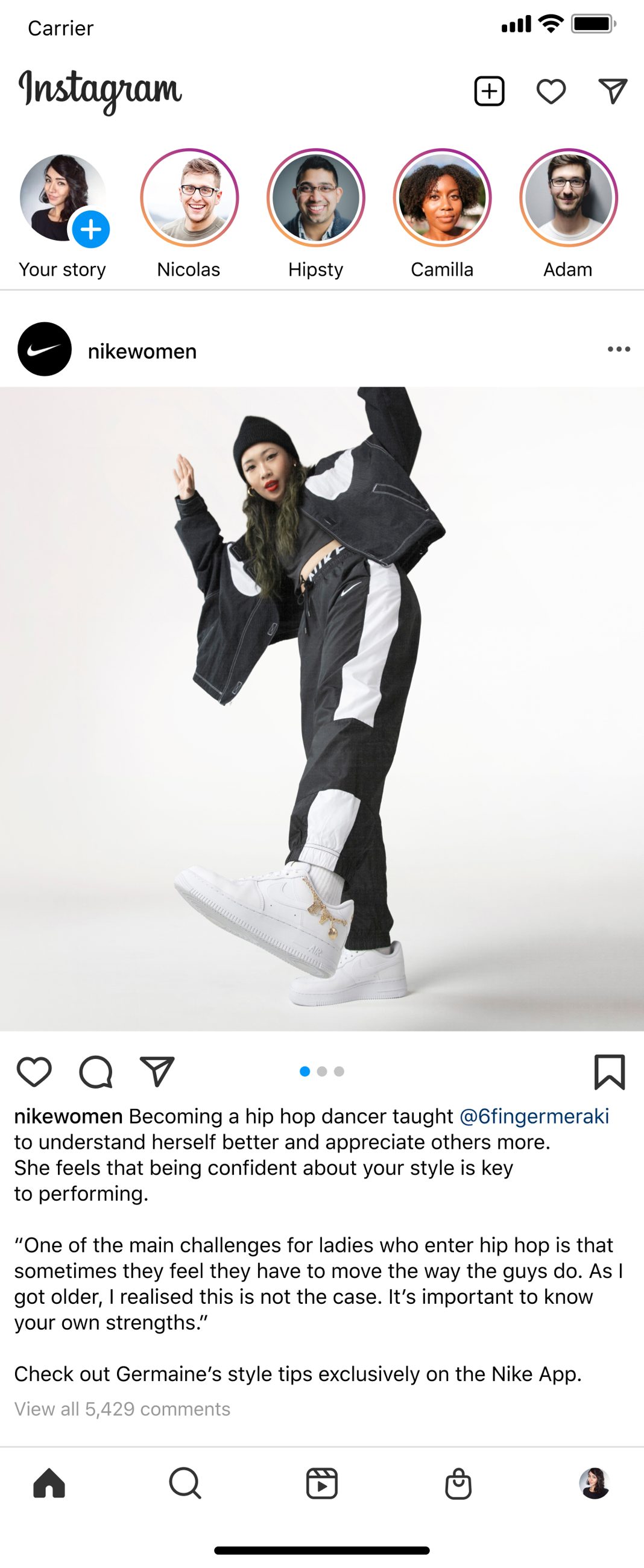
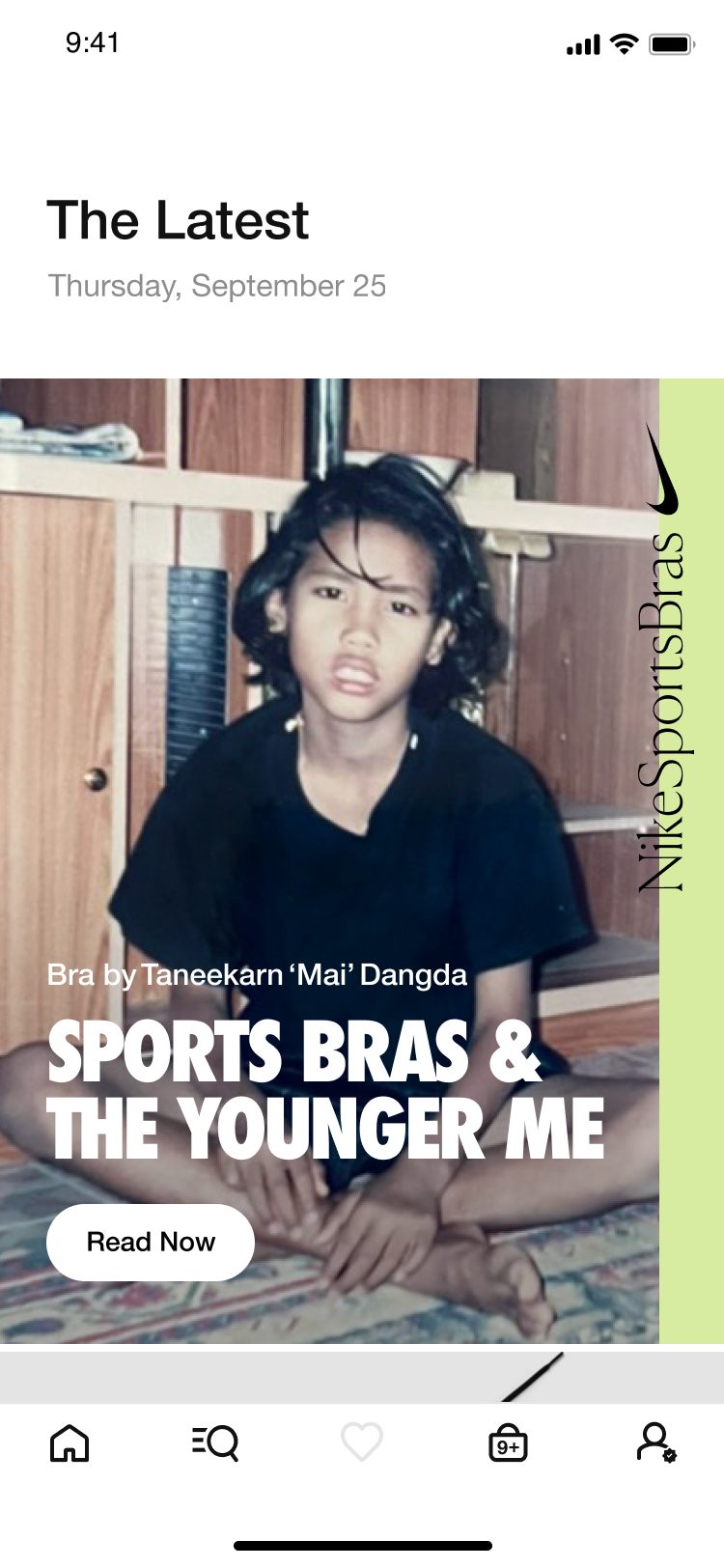
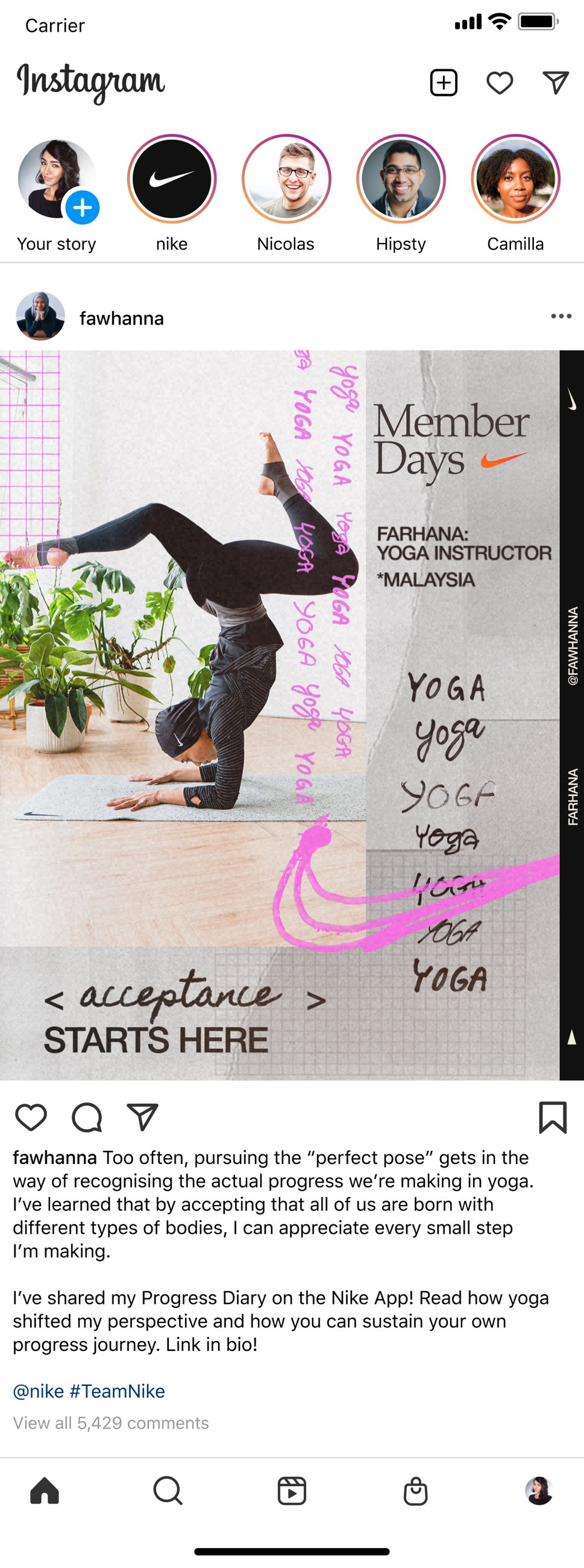
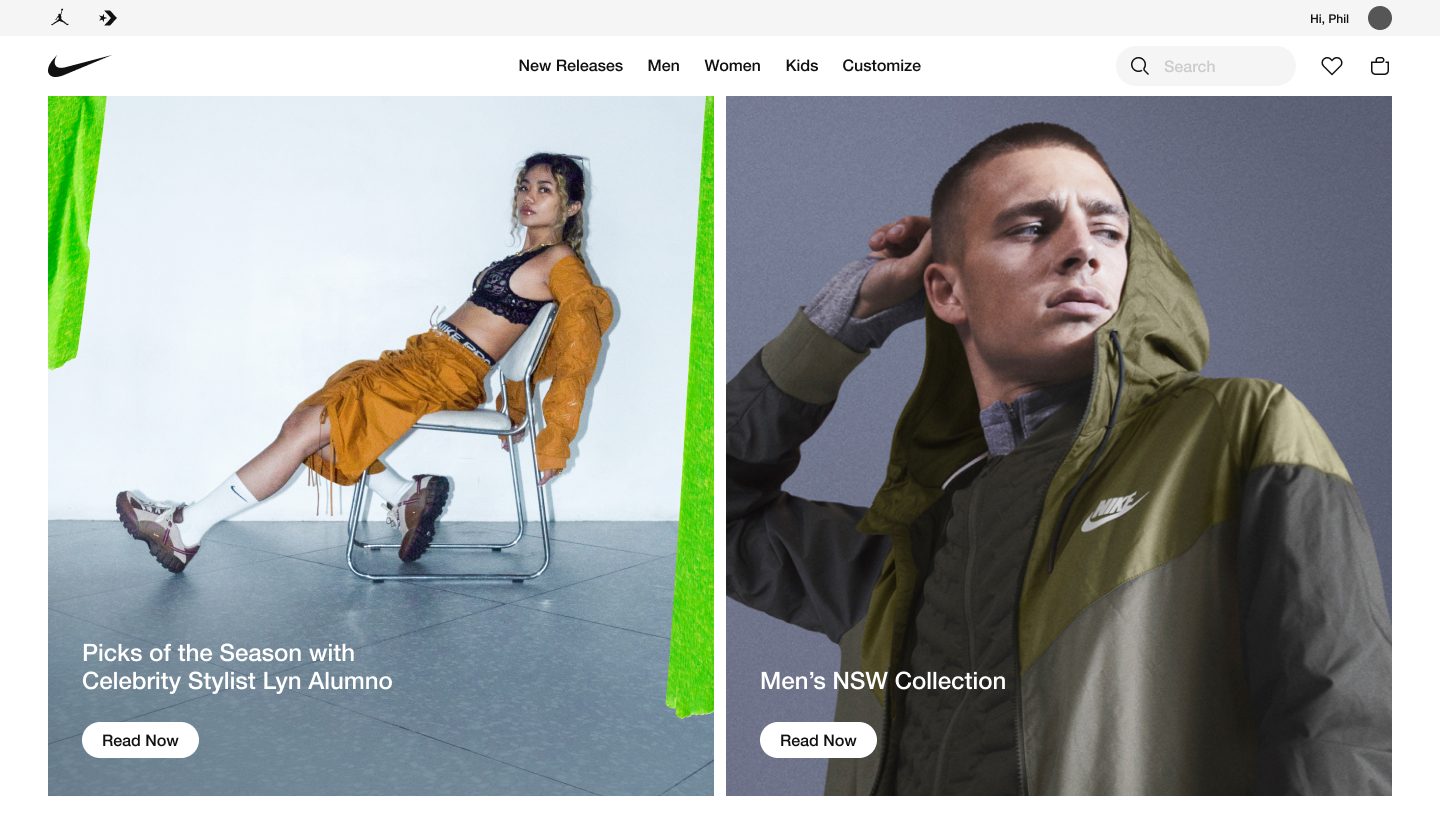
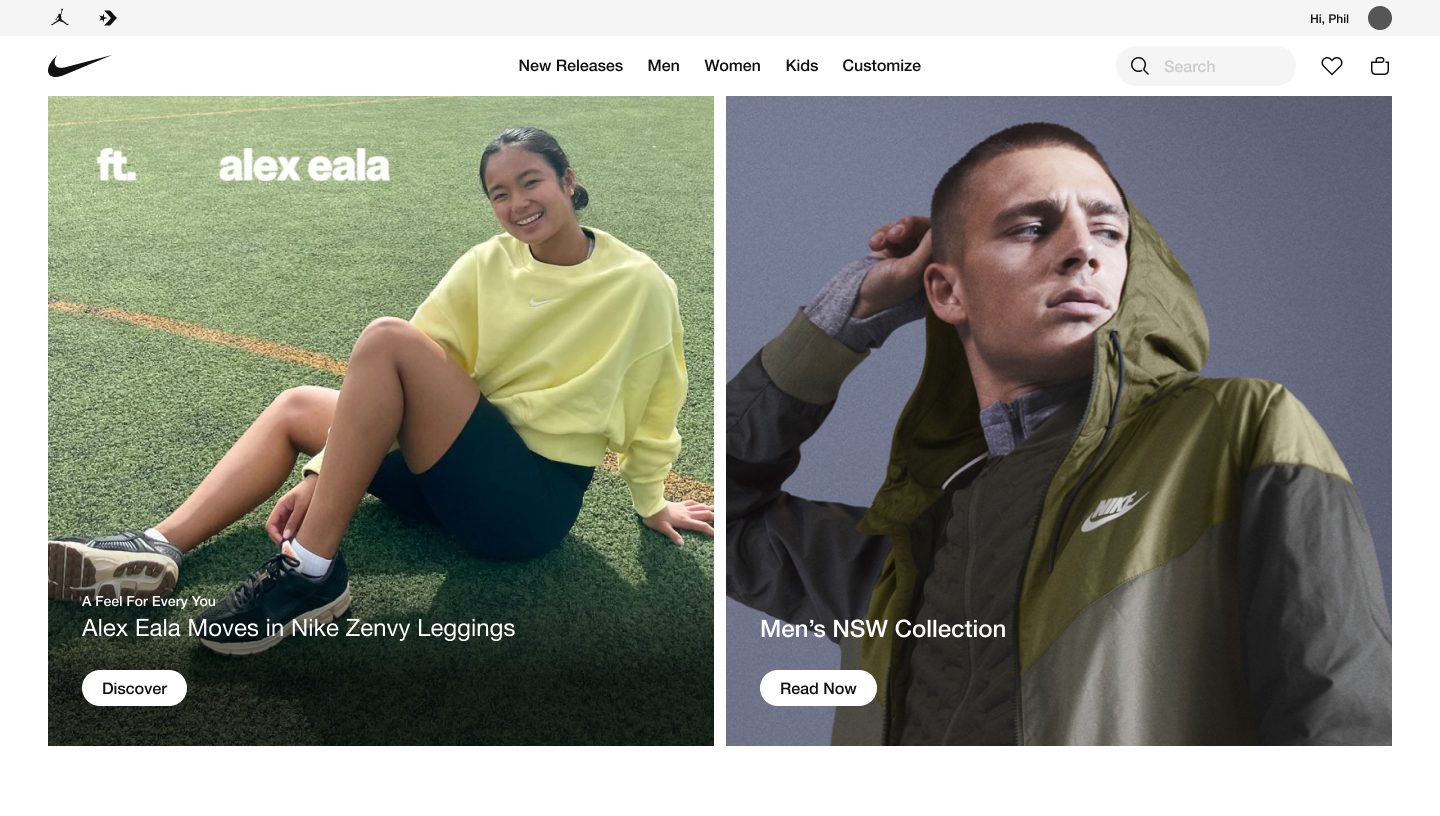
Seasonal member programmes like Style Goals You, athlete stories like Alex Eala in the Philippines, Air Max and fitness series. Content built to run on nike.com, in the app and in the inbox at the same time, week after week.
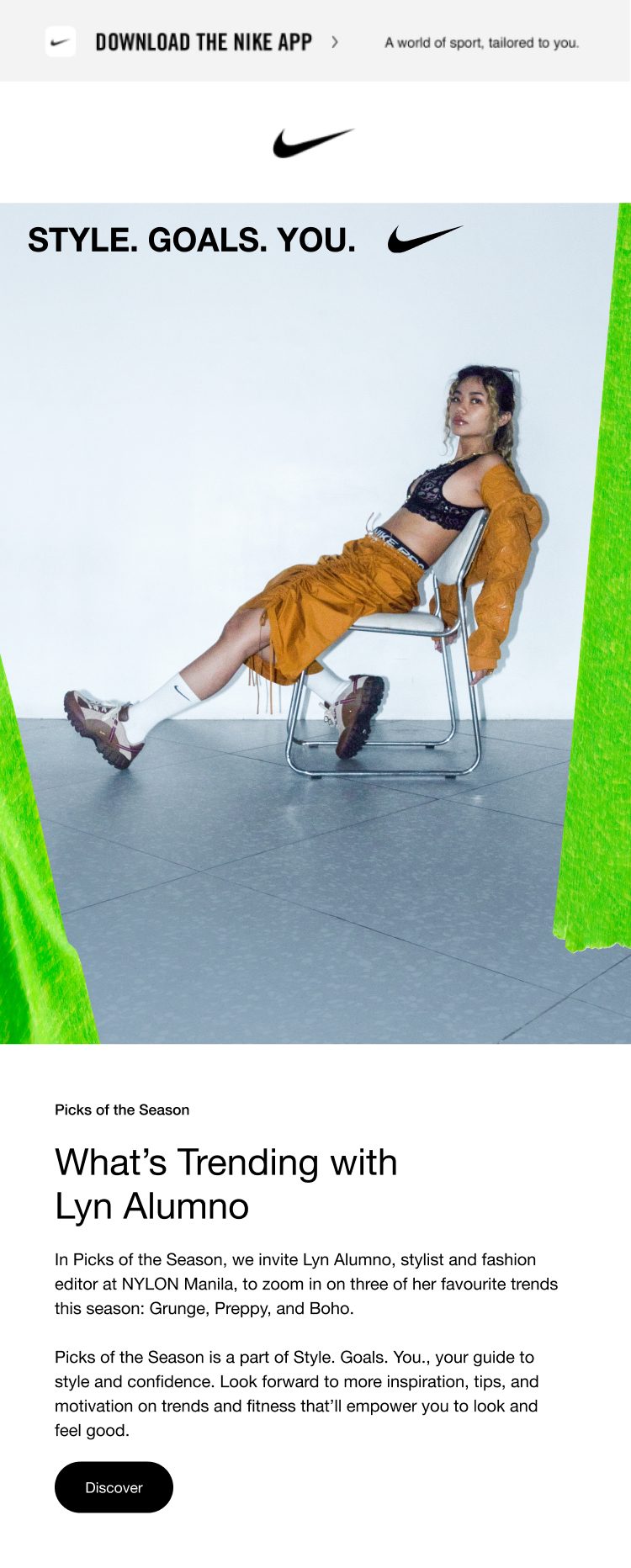
Hoops Hub in the app as the home. Super Hoops, a playable game with real rewards. Her Hoops, a women's 3x3 tournament. Flight Camp, a jumbotron moment in the arena, a Luka vs Luk AI challenge. One idea in every member channel.
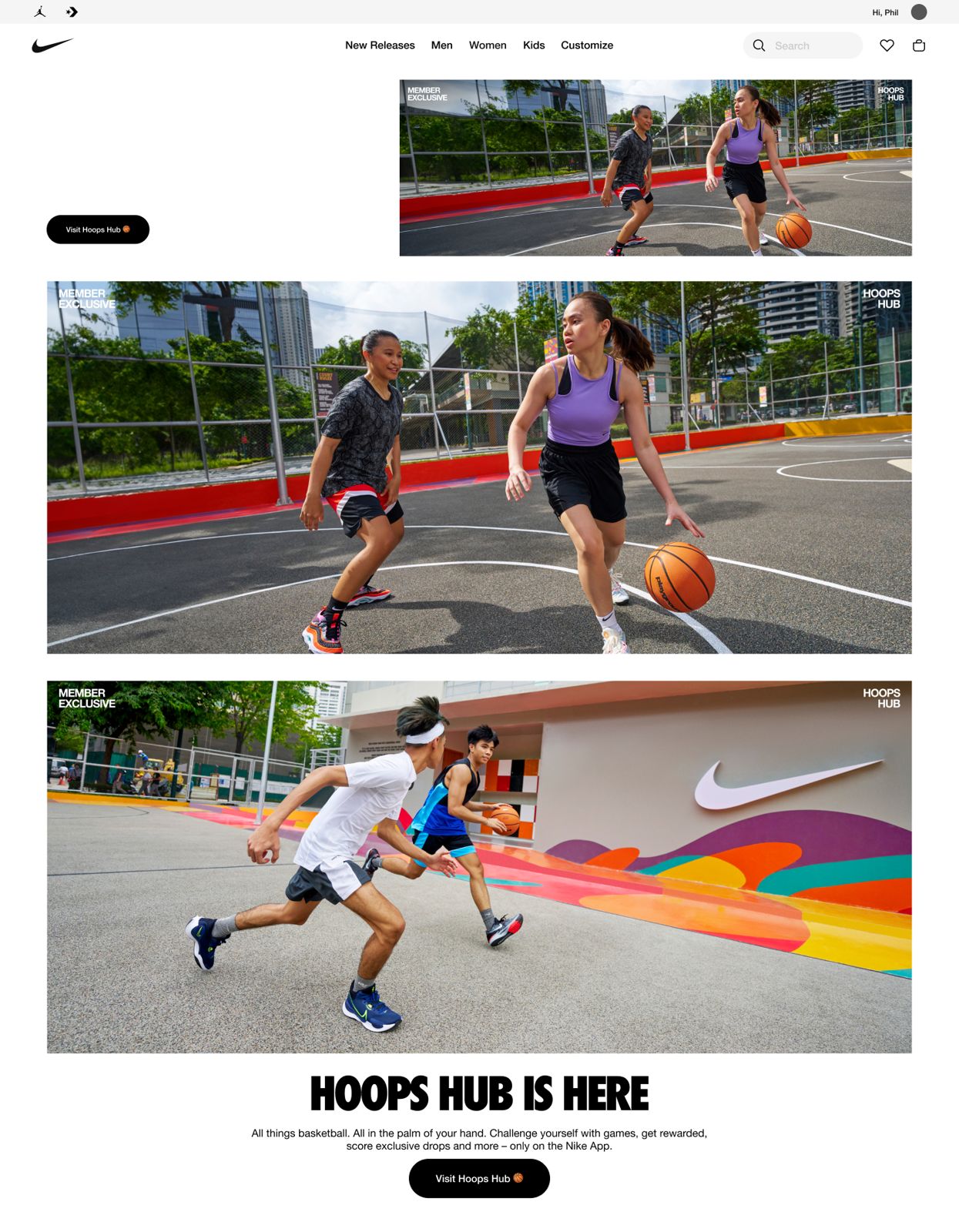
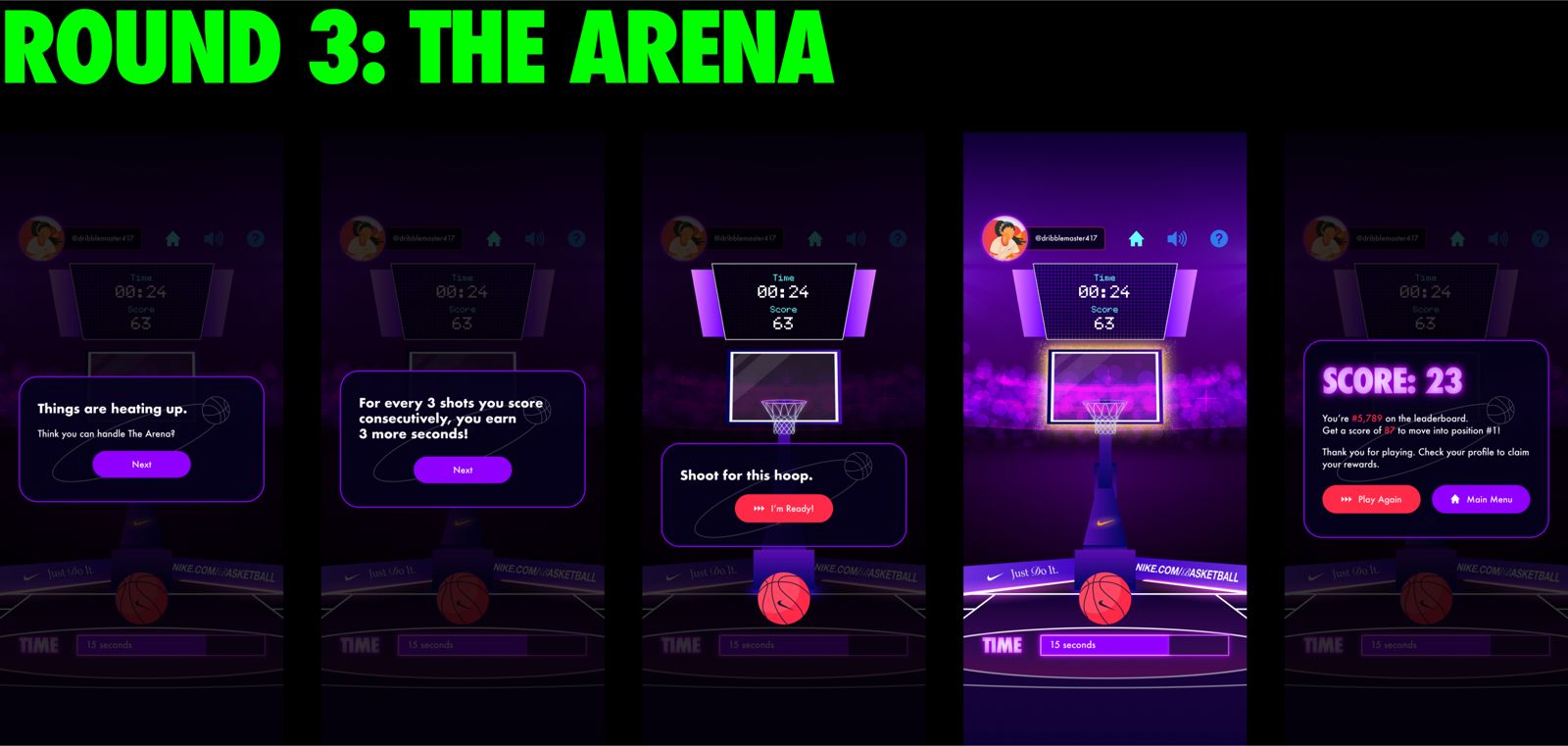
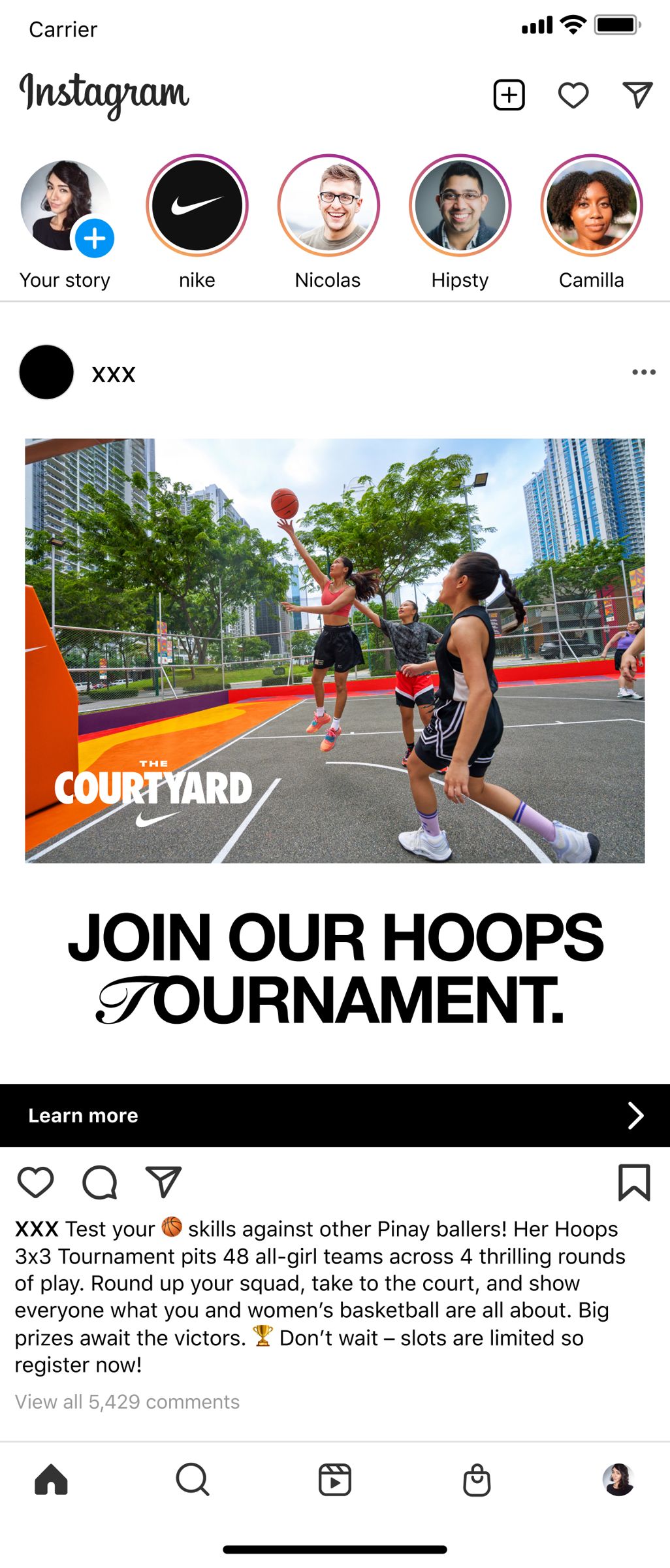
Four years, five markets, every week. The creative idea is half the job. The other half is the system that lets it reach a member forty times without feeling like forty messages.
In 2017 RAPP Asia Pacific was three people and one project. Juniper Networks was that project. An enterprise networking brand with a technical story and a regional audience that didn't yet know why it should care.
What does our client need to be true on Monday morning? Not what do we want to make. What does the person across the table need to walk into their own leadership meeting with.
Treat enterprise B2B as a brand problem, not a lead-gen problem. Build the narrative first, then the content engine under it. Measure what the client's business measured, and show up with that number before being asked.
When the client moved to Google Cloud, the work followed. We launched Google Cloud APAC's first YouTube series and led owned and paid creative strategy. One relationship, held for eight years across two of the most demanding technology brands in the world. It anchored the practice while we built everything else.
Why does a client take an agency with them? Because the work was never about the agency.
This is the story I'd tell a CMO before any of the Mercedes-Benz work, because it is the one that shows how I think about trust. A client who changes companies has a hundred reasons to start fresh. They bring you along for one reason only. You made their job easier, measurably, more than once, and you never made it about you.
It is also the story that explains why I want to be in-house. Eight years on one relationship is what agency people call a long tenure. In-house, it's called the first chapter.
Commercial judgement, B2B technology fluency, and the kind of trust that outlasts a job title.
September 2017. One project client, no operating infrastructure, three founding hires: the regional president, the managing director and me. The brief was not to win clients. It was to build a regional creative practice from scratch that could hold under live delivery from day one.
What would make this practice run well on a day I'm not in the room? Everything I built was an answer to that.
Leaders before volume. I hired senior people first and built execution teams under them, which is slower to ramp and far more durable. The operating model came before the first piece of client work: review process, hiring rubric, onboarding, pitch framework, quality assurance. Market leads got real decision rights inside global guardrails, so nothing had to crash its way up to Singapore.
From three people to more than 120 across seven markets in three years. Ten senior leaders hired, eight in ten retained and promoted. Review cycles cut from four weeks to two. I covered the managing director and creative director roles at the same time through two leadership transitions without a drop in delivery. The practice still runs on these fundamentals.
Personality scales until it doesn't. Systems compound.
Most new practices hire for the work in front of them and build the operating model later, when the pain gets loud. I did it the other way round. Hiring rubric, review framework and decision rights were written before we had the people to use them. It felt slow for the first six months. It is the reason the practice outgrew its founders.
I care about talent more than almost anything else in this work. The practice ran career conversations on a written framework, with self-reflection first and the manager second. Senior leaders and junior hires both got investment in strategy, ideation and quality of craft. The things volume cannot teach.
Building seven offices means hiring in seven cultures, with seven ideas of what a good creative review looks like. The system had to be clear enough to travel and loose enough to let Seoul be Seoul. That tension never went away. It became the job.
RAPP was later named Campaign UK Global Digital Transformation Agency of the Year in 2024 and 2025. The regional operating culture set in these years was part of that story.
I'm a builder. Give me ambiguity and a mandate, and I will give you a team that still works after I've moved on.
In mid 2023 generative tools were good enough to change how a creative team worked and not yet governed by anyone. Waiting for the network to issue a policy meant falling behind clients who were already asking.
Where does this make our thinking better, and where does it just make our output faster? Those are different questions with different rules.
Run it in the open. I started with a creative-sharing session on image generation in June 2023, then codified use cases, tooling and guardrails for the region: what tools were allowed, for which stage of the work, with what disclosure to clients. The region became the network's testbed rather than a follower.
A creative practice that could use AI for ideation and exploration without compromising client confidentiality or craft standards, in place before the global mandate. I went on to complete Anthropic's AI Fluency certification in April 2026 and use these tools daily, including to build this site.
The tools are not the strategy. The judgement about where to use them is.
What I learned running this is that the hard part is never the technology. It is the conversation with a senior art director who thinks the tool devalues her craft, and the conversation with a junior who thinks it replaces the need to learn any. Both are wrong in interesting ways, and a leader's job is to hold the room while they find that out.
Any in-house brand team is having this conversation right now. I have already had it, with 120 people, across seven cultures.
Curiosity with discipline. I move early, and I write the rules down as I go.
Short pieces on how I see brand, leadership and the work of building. New ones get added as I write them.
Most brand problems I've been handed were governance problems wearing a creative costume.
5 minute readIn April 2026 I called a government agency that had existed for three weeks and asked for twenty minutes. They gave me sixty.
6 minute readAmbiguity is not a problem to be removed. It's the condition the work happens in.
4 minute readThe most dangerous person in a brand meeting is the one who already knows the answer.
4 minute readMost brand problems I've been handed were governance problems wearing a creative costume.
When a brand looks inconsistent across markets, the instinct is to fix the creative. New guidelines, a tighter template, a sharper agency. I've been that agency. It rarely works for long, because the inconsistency was never a creative failure. It was a decision failure. Nobody had agreed who decides what, so every market decided for itself.
Think of a brand the way you'd think of a city's water system. The visible part, the tap, is the campaign. What makes the tap work is everything underneath: who owns the pipes, where the pressure is set, what happens when two neighbourhoods want different things. A brand that holds across 30 markets has a decision-rights matrix, an escalation path, a review cadence and a clear line between global intent and local expression. Those are not creative artefacts. They are infrastructure. And like infrastructure, nobody notices them until they fail.
The practical consequence for a Head of Brand is that the first six months should be spent on plumbing, not on a new campaign. Who signs off on what. Which decisions sit with the market. What "on brand" means in a sentence a product manager can use. It's unglamorous. It is also the only thing I've seen reliably produce braver work, because people take creative risks when they know where the edges are.
On Mercedes-Benz, the single most useful thing we did for the region was not a launch film. It was writing down that the market lead held the editorial call on cultural translation, and that global held the call on intent. Once that was true, review cycles halved, and the work in each market got more specific, not less.
Governance is a creative tool. That sentence has taken me twenty years to believe.
In April 2026 I called a government agency that had existed for three weeks and asked for twenty minutes. They gave me sixty.
A new national agency had just been formed in Singapore. International partnerships signed before the doors opened, legislation still being written, a mandate to be both enabler and regulator of an industry that barely existed locally yet. I found that fascinating, so I rang the chief executive and offered a point of view. No pitch, no fee. Twenty minutes of me, and then whatever they wanted to ask.
I presented for twenty minutes. They asked questions for forty. Here is the thinking I brought, because it applies to any organisation in its first year.
A new institution speaks to three rooms at the same time. International partners want a credible, consistent counterpart. Local industry wants to know one thing: are you an enabler, a gatekeeper, or both? And the public wants accountability, and a reason to believe the investment is worth it. Each room hears a different sentence. The work is deciding which sentence is the spine and which are the limbs.
When the enabler and the regulator want different things from the same announcement, who arbitrates? If the answer is "whoever is in the room that day," the voice will set itself, by accident, within a year. Legislation being unwritten is not a problem. It's the cheapest moment there will ever be to decide.
The partnerships were built on relationships, which is how all early partnerships get built. The question I left them with: what happens to a partnership when the people who built it move on? A clear, repeatable story is how institutional wins survive personnel change. It's also what lets you hire ahead of your budget, because a good engineer can picture what they'd be joining.
My closing line was that voice was not their biggest problem. Talent and delivery were. But voice was their cheapest fix, and the one that made the other two easier.
I didn't get a job out of it. I wasn't looking for one. I got sixty minutes inside a problem I'd never seen before, which is the thing I'd do this work for even if nobody paid me.
Ambiguity is not a problem to be removed. It's the condition the work happens in.
Every brief I've ever received was missing something. The budget, the real decision-maker, the actual business problem under the stated one. Early in my career I treated that as a failure of the brief. Now I treat it as the brief. The gap is where the job is.
Building a regional practice from three people taught me that ambiguity doesn't resolve. It gets replaced by new ambiguity. Seven markets, seven cultures, clients changing companies, a network changing its mind. If I had waited for clarity before acting, we'd still be three people. What I learned to do instead is find the first clear decision inside the mess, make it, and let it create the next one.
That sounds like a personality trait. It's a method. Separate what is unknown from what is undecided. Unknowns need information, so go and get it, fast and roughly. Undecideds need a decision-maker, so name one. Most chaos in brand teams is undecideds pretending to be unknowns, because a decision creates accountability and more research doesn't.
The second part of the method is caring about the detail at the right moment. I hold the big picture by default. But there are moments when a single line of copy, a single hiring choice, a single colour decides whether the big picture lands. Knowing which moment is which is most of what twenty years has given me.
What I want from an in-house role is more of this, not less. The brands I admire are not the ones that have removed the chaos. They are the ones that have built a team that is calm inside it.
The most dangerous person in a brand meeting is the one who already knows the answer.
After enough years, every creative leader develops a move. The thing that worked at the last three companies. It's tempting to lead with it, because it's efficient and because people hired you for it. I think it is the beginning of the end of being useful.
The insight that made the Mercedes-Benz EV programme work in Singapore and Malaysia was that the two markets should not run the same way. Different price points, different purchase triggers, different reasons to doubt an electric car. The surefire way was one regional campaign. The right way was two, built on ground events and targeted digital, and it grew sales in both markets within a quarter. The data said the markets were similar. The behaviour said they weren't. I've learned to go looking for that gap.
So the method is simple to describe and hard to keep doing. Start with the question, not the answer. Question the data before trusting it, because data tells you what people did, not why. Put the strategist, the creative and the person who owns the number in one room early, and keep them there. The idea comes out of that collision, not out of anyone's playbook.
It also means being direct when the room is drifting toward the comfortable answer. Collaboration is not consensus. I'd rather be the person who says the uncomfortable thing at the right moment than the one who was agreeable and wrong.
If you hire me, you are not hiring a move. You're hiring someone who will still be asking what we don't know yet in year three.
I'm Joelene Tee. Joe to most people. I've spent twenty years in brand and creative work, the last eight of them as Creative Director and then Executive Creative Director for Asia Pacific at RAPP, Omnicom's precision marketing network. I was one of three founding hires and built the creative practice from nothing to more than 120 people across seven markets.
I started as a designer. I became an art director, then a creative director, then someone who runs organisations. Each step kept the previous one. I still write copy. I still build the deck when the deck matters. I still direct the shoot when the shoot decides the brand. I just also know how to hire the people who do those things better than me, and how to build the system they work inside.
What I care about: the people, the culture, and whether a creative solution resonates with the audience it was made for. That comes from a good insight, which comes from questioning the data, which comes from putting the right people in a room and not letting anyone leave with the brief half understood.
I'm Chinese-Eurasian and grew up in Singapore, which means I've spent my whole life watching meaning shift between two cultures in one house. It's why I'm hard on cultural accuracy in leadership, communication and the work itself. Resonance isn't a tone. It's whether the audience recognises themselves.
Gallup's CliftonStrengths puts me as Arranger, Strategic, Achiever, Individualization and Analytical. The people I've worked with would say I bring the matrix together, I'm direct, and I care about growing the people I lead more than I care about being the smartest person in the room.
Outside work I'm usually planning a hike or a festival somewhere I've never been. I live in Singapore with my partner and our dogs.
"One of those exceptional creative leaders who can build an organization from the ground up while simultaneously elevating the work that defines it. Vision, craft depth, commercial intuition and organizational leadership, all in one person."
Troy Hitch, Global Chief Creative Officer, RAPP, Omnicom
"She combined strong regional leadership with a genuinely hands-on working style, remaining deeply involved in the work while empowering local leaders and creative teams to do their best work. This balance is rare."
Daniel Menges, President APAC, RAPP, Omnicom
"I worked closely with Joelene for many years while building RAPP Singapore and APAC from a team of three to a 120+ strong organisation. She was instrumental to that growth. Her work goes beyond aesthetics. She thinks in terms of customer journeys, products, media formats and whatever best solves the business problem."
Wolfgang Kaller, Growth and CRM Lead, Omnicom Precision Marketing Germany
Certified in AI Fluency by Anthropic, 2026. Digital Marketing Strategies, Kellogg School of Management, 2020. User Experience Design, General Assembly, 2017. Diploma in Visual Communications, Temasek Polytechnic.
Send me the job description, the problem behind it, or a time to talk. I reply within a day.